When your child asks to read the Bible alone, you may wonder which edition will actually make sense: a storybook Bible, a simplified translation, or the same version adults use at church. The best children's Bible translation is not automatically the one with the biggest pictures or shortest sentences. It is the version your child can understand, read with reasonable confidence, and connect with accurately.
For many young readers, that means choosing a Bible written in clear contemporary English, with a readable page design and helpful explanations. Older children may be ready for a standard translation with study notes, while younger children often benefit from an adult reading aloud alongside a carefully selected children’s edition.
A Bible translation presents the books of the Bible in another language. A children’s Bible translation usually uses vocabulary, sentence structure, and page design intended to help younger readers. It may also include maps, introductions, illustrations, pronunciation help, notes, and questions.
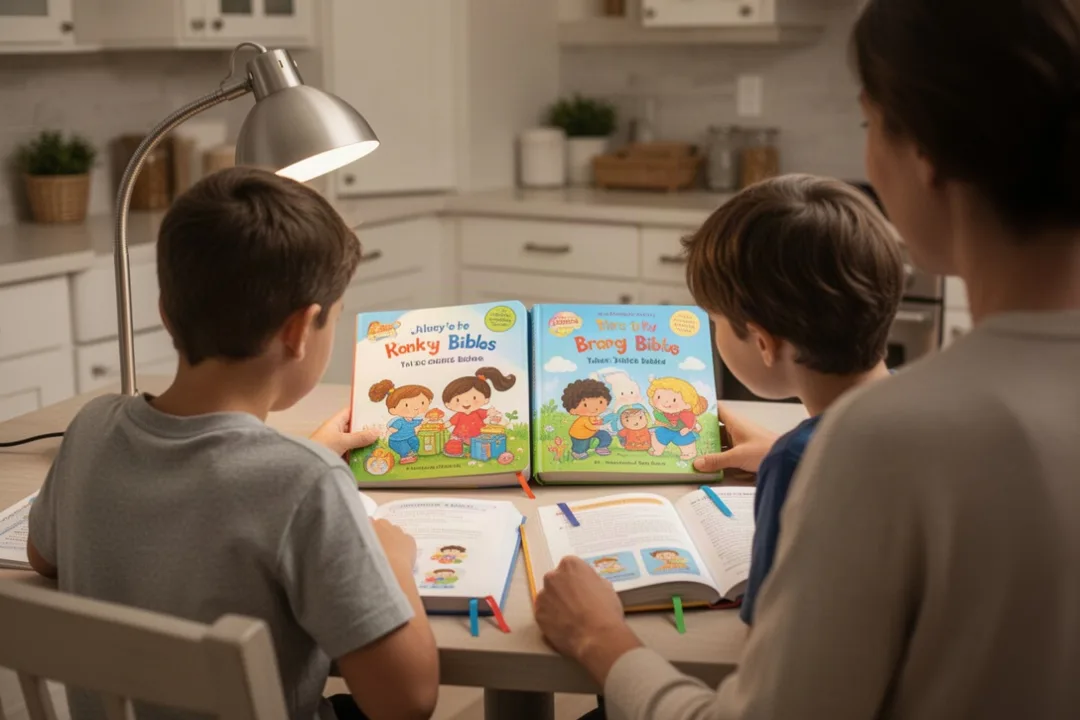
That is different from a children’s Bible storybook. A storybook retells selected Bible accounts in shortened form and may leave out genealogies, letters, laws, poetry, and difficult passages. It can be useful for early learning, but it is not the complete Bible and should not be evaluated as though it were a translation.
Publishers use different approaches when translating Scripture. Some aim to stay close to the structure and wording of the original languages. Others prioritize natural English and explain the meaning in language that sounds familiar. Most widely used translations fall somewhere between those two approaches.
Quick distinction: A Bible storybook introduces children to major biblical stories; a children’s Bible translation gives them the full biblical text in language they may be able to read themselves.
How to choose the right children’s Bible translation
Choosing a Bible becomes easier when you treat it as a match between the child, the edition, and the setting in which it will be used. Work through these steps before buying a particular cover or format.
Identify the child’s reading stage. Ask whether the child is listening, learning to decode words, reading short books independently, or handling longer chapters with little help.
Check the translation’s language. Read a few pages aloud. Look for familiar vocabulary, manageable sentence length, and wording that sounds natural without becoming vague.
Separate text from study features. A colorful cover cannot compensate for text that is too difficult. Review the actual Bible passages as well as the notes and illustrations.
Consider your church or family tradition. If the child hears one translation at church, a matching edition can make worship and home reading less confusing.
Look at the complete package. Check print size, paper quality, page layout, chapter headings, pronunciation guides, maps, and whether the book is comfortable to hold.
Test it with the child. Let the child read a passage and explain what happened. A suitable edition should support understanding, not simply make every word easier.
Try passages from several parts of the Bible rather than judging a translation from one familiar story. Read a narrative from one of the Gospels, a poem from Psalms, a section from Proverbs, and a paragraph from one of the New Testament letters. A version that works well for stories may still feel difficult in poetry or explanatory writing.
Which Bible translations are often suitable for children
No single version is best for every child, but several English translations are commonly considered accessible for younger readers. Their wording, notes, and available editions differ, so compare an actual print or digital sample before making a decision.
New International Reader’s Version
The New International Reader’s Version, often called the NIrV, was created with beginning readers in mind. It generally uses shorter sentences and simpler vocabulary than the standard NIV. That can help children who understand Bible ideas when an adult explains them but struggle to read longer sentences independently.
The NIrV can be a practical choice for early independent reading, family devotions, and children who are building confidence. Some families later move to the NIV or another standard translation after the child becomes a stronger reader. Check the edition’s notes and illustrations, because children’s versions can differ considerably in how much support they provide.
Contemporary English Version
The Contemporary English Version, or CEV, uses conversational English and tends to avoid complicated sentence structures. It is designed to be understood when read aloud, which makes it useful for family reading, children’s groups, and readers who find traditional biblical phrasing unfamiliar.
Its natural sound may help children follow the action and main idea of a passage. As with any accessible translation, adults should still discuss unfamiliar concepts and literary forms. Simple wording does not remove the need to explain ideas such as covenant, sacrifice, prophecy, wisdom literature, or the structure of the letters.
International Children’s Bible
The International Children’s Bible, commonly known as the ICB, is written specifically with children in mind. Its language and sentence patterns aim to support younger readers, including children who are reading independently for the first time.
An ICB edition may be especially helpful for a child who needs a direct, uncomplicated presentation of the text. Compare the page layout carefully: large type, generous spacing, and clear headings can make as much difference to a developing reader as the translation’s vocabulary.
New Living Translation
The New Living Translation, or NLT, is not exclusively a children’s translation, but many children and families find its contemporary English approachable. It often reads smoothly aloud and can make the flow of a narrative or letter easier to follow.
It may suit older children, family reading, and children who are ready for a full Bible but do not enjoy formal or highly traditional wording. The NLT is still a complete Bible, so some sections will contain difficult ideas and less familiar terms. A children’s edition with notes can provide useful context without replacing the biblical text.
New International Version and other standard translations
The New International Version, or NIV, is widely used in churches, schools, and families. It can work well for older children who read comfortably or for younger children who read with an adult. Having the same translation at home and church may help a child recognize passages more easily.
Other standard translations, including the Christian Standard Bible, may be appropriate for older readers depending on their reading ability and family tradition. The English Standard Version and New American Standard Bible tend to use more formal or structurally close wording, which some families prefer for study. They may require more adult explanation for children who are still developing reading fluency.
How age and reading ability affect the choice
Age provides a starting point, but it should not be the only measure. Children of the same age can differ widely in vocabulary, attention span, reading fluency, and familiarity with church language. A strong reader may manage a standard translation early, while an older child with dyslexia, a language delay, or limited exposure to biblical vocabulary may need a more accessible edition.
Preschool children: Use a Bible storybook, picture Bible, or an adult-read Bible passage. Focus on hearing the language, asking questions, and seeing how individual stories fit into the larger biblical account.
Early elementary readers: Consider a children’s translation with large print, short paragraphs, and illustrations or notes. Read together regularly rather than expecting complete independent use immediately.
Middle elementary readers: Compare an accessible translation with a standard version used at church. Children at this stage may enjoy maps, timelines, character notes, and short explanations of unfamiliar customs.
Older elementary and middle school readers: Choose a complete translation that respects the child’s growing ability to handle poetry, letters, historical detail, and more challenging themes. Study features become increasingly valuable.
Teens: Let the teenager compare translations and choose a format they will actually read. A standard Bible with cross-references, introductions, and notes may be more useful than a heavily illustrated children’s edition.
Reading level is only one part of comprehension. A child might pronounce every word in a passage but still misunderstand who is speaking, what happened before, or why the event matters. Ask the child to retell the passage in their own words; that gives you better information than speed or smooth pronunciation alone.
Why readability does not mean removing difficult ideas
A good children’s Bible translation simplifies language, not the whole message of the Bible. Children will encounter grief, injustice, violence, betrayal, judgment, illness, death, and difficult moral questions. Omitting every challenging passage can leave them unprepared for the Bible as it actually is.
The goal is not to hide difficult material, but to provide age-appropriate guidance. An adult might explain historical setting, distinguish description from instruction, or acknowledge that Christians interpret a passage in different ways. A child can be told that a passage is hard without being made to feel that questions are unwelcome.
Some editions use notes to define words or describe cultural practices. Others may frame a story with a devotional lesson. Read those additions carefully. Study notes are interpretations, not part of the biblical text, and they may reflect a particular denomination or theological perspective.
Use guidance, not avoidance: When a passage raises a difficult question, read it with the child, explain what you can, and say honestly when Christians have more than one interpretation.
How translation style changes a child’s experience
Translation style affects how a child hears the Bible. A more formal version may preserve familiar phrases and traditional wording, but its sentence structure can feel distant to a new reader. A more dynamic translation may sound like ordinary speech, although it can make some poetic or repeated wording less obvious.
Neither approach automatically makes a translation accurate or inaccurate. Reliable translations are produced through substantial editorial and translation work, yet they make different choices about how to communicate meaning. Looking at more than one version can show children that wording may vary while the passage’s central message remains recognizable.
For example, biblical poetry often uses repetition, imagery, and parallel lines. A child-friendly edition may explain the image in more direct words, while another translation may preserve the figurative language. Both can have value: one supports immediate understanding, and the other encourages children to notice how the text is written.
“Your word is a lamp for my feet and a light for my path” is the idea expressed in Psalm 119:105, where the writer describes God’s instruction as guidance.
That paraphrase illustrates why reading a passage in context matters. A short, memorable sentence can be meaningful, but children also need to see the surrounding verses and understand whether they are reading a song, a proverb, a historical account, a prophecy, or a letter.
What features make a children’s Bible easier to use
The physical and editorial design of a Bible can determine whether a child returns to it. Choose features that address a real need rather than adding decoration for its own sake.
Readable type: Look for print large enough to read comfortably and pages with enough white space to keep lines from running together.
Clear navigation: Strong chapter and verse markings, a contents page, and page numbers help children find passages without constant assistance.
Helpful introductions: Brief explanations of each book can identify its genre, setting, main themes, and place in the Bible.
Maps and timelines: These can clarify where events occurred and help children distinguish different periods of biblical history.
Pronunciation support: A guide can make unfamiliar names and places less intimidating when children read aloud.
Cross-references: These show connections between passages and become more useful as a child learns to study independently.
Balanced notes: Definitions, cultural background, and comprehension questions can support reading when they do not overwhelm the page.
Durable construction: A sturdy binding and paper that turns easily matter for a Bible that will be carried to church or used every day.
For children with visual, motor, or learning differences, consider accessibility beyond translation choice. An audio Bible, digital text with adjustable size, dyslexia-friendly formatting, or a read-along routine may make Scripture more available than a traditional print edition alone.
How families can read a children’s Bible translation together
Children usually understand more when Bible reading is interactive. You do not need a long lesson every time. A short passage, one clear question, and a chance for the child to respond can build stronger comprehension than reading several pages without conversation.
Set the scene. Identify the book, the people involved, and what has happened immediately before the passage.
Read in manageable sections. Stop at natural breaks instead of requiring a young reader to finish a whole chapter.
Ask observation questions. Ask what happened, who spoke, what changed, or which words were repeated.
Explain unfamiliar language. Define names, customs, places, and religious terms briefly and accurately.
Connect the passage carefully. Discuss what the text teaches without forcing a personal lesson that the passage does not support.
Compare translations when useful. Show how two versions express the same sentence and ask which wording is easier to understand.
Keep questions open enough for real discussion. “What do you notice?” often produces a better conversation than asking a child to guess the answer an adult has already chosen. If the child asks something you cannot answer, acknowledge the question and return to it later rather than inventing certainty.
Common mistakes when buying a Bible for a child
One common mistake is choosing by age label alone. A Bible marked for a certain age range may still be too difficult for one child or too basic for another. Look at sample pages, especially from books outside the familiar stories of Genesis, the Gospels, and Exodus.
Another mistake is assuming that simpler always means better. A child who is ready for a fuller translation may feel talked down to by a very basic edition. Conversely, a formal Bible may discourage a child who is eager to read but needs more support with vocabulary and sentence structure.
Some adults also confuse a devotional Bible with a translation. A devotional edition adds reflections, prayers, questions, or application notes around a biblical text. Those extras can be valuable, but compare the underlying translation and make sure the devotional comments are clearly distinguished from Scripture.
Finally, avoid treating one Bible as a permanent decision. Children grow, reading skills change, and interests develop. A storybook Bible may be right at age four, an accessible complete translation at age eight, and a standard study Bible a few years later.
How to compare translations before you buy
Use a library, bookstore, church resource shelf, or publisher sample to examine several editions side by side. Start with passages you know, then test sections that reveal different translation challenges. Read silently and aloud, because a Bible that looks easy on the page may sound awkward when spoken.
Read one narrative passage and ask whether the sequence of events is easy to follow.
Read a psalm and look for imagery, rhythm, repetition, and emotional clarity.
Read a short teaching passage from a Gospel and check whether the main point is clear.
Read a paragraph from one of Paul’s letters and note sentence length and logical connections.
Review a difficult or unfamiliar passage to see whether notes offer context without giving simplistic answers.
Ask the child which edition feels inviting and which words or pages caused trouble.
Pay attention to the translation’s stated approach, usually described in the publisher’s introduction or product information. Then judge the result by actual reading. A label such as “easy to read” is helpful, but it cannot replace seeing whether the child understands and wants to continue.
When a child should use more than one Bible translation
Using two translations can be helpful once a child has enough reading ability to compare them without becoming confused. Keep the purpose simple: one version may make the meaning clearer, while another may preserve wording the child hears at church or sees in a study resource.
Comparison is especially useful for teaching that translations are careful attempts to communicate ancient texts, not competing sets of different Bible stories. Explain that wording can vary because translators make decisions about grammar, idioms, poetry, and words that do not have one exact English equivalent.
Do not turn every reading session into a technical exercise. For younger children, consistency matters more than comparison. Introduce a second translation when it answers a genuine question, helps clarify a difficult sentence, or supports a child who is beginning to study passages more independently.
How to support children who struggle with Bible reading
If a child avoids reading, first find out what creates the difficulty. The problem may be small print, unfamiliar names, long chapters, limited background knowledge, or anxiety about making mistakes aloud. Changing the translation may help, but so can an audio recording, shorter sessions, or shared reading.
Let the child alternate paragraphs with an adult or listen while following along in print. Preview names and places before reading, and choose a quiet setting with few distractions. For a child with a diagnosed reading difference, ask a teacher or reading specialist which formats and accommodations are likely to help.
Celebrate understanding rather than performance. A child who can explain the main idea, ask a thoughtful question, or connect two passages is engaging meaningfully even if reading aloud remains slow. The long-term goal is confident, honest engagement with Scripture, not simply finishing a certain number of pages.
How faith tradition should influence your choice
Families may prefer a translation associated with their denomination, congregation, or tradition. That preference can make shared reading easier, especially when children hear the same wording during worship, Sunday school, or religious education.
Some traditions also differ in which books are included in the Bible and which study notes are considered appropriate. If your family uses a Catholic, Orthodox, Jewish, or other faith-specific edition, check that the children’s Bible reflects the collection and terminology your community teaches.
When a child attends a church or school that uses a different translation, there is usually no need to treat the difference as a problem. Explain that several English translations may be used, and identify the edition by name. This gives the child practical confidence when moving between home, worship, classroom, and personal reading.
What a good choice looks like in practice
A suitable children’s Bible translation lets the child participate rather than merely receive information. The child can find a passage, read at least part of it with appropriate support, follow the basic meaning, and ask questions about what remains unclear.
For one child, that may be an illustrated ICB or NIrV edition. For another, it may be a CEV or NLT with family discussion. An older child may prefer the NIV, CSB, or another standard translation used by the family. The right choice is the one that combines accurate biblical content, accessible language, thoughtful guidance, and practical usability.
Revisit the choice as the child grows. Replace a damaged or outgrown edition, introduce a standard translation when reading skills mature, and continue reading together when the text becomes more demanding. A children’s Bible works best not as a one-time purchase, but as a tool that develops alongside the reader.
Frequently asked questions
Is a children’s Bible translation different from a regular Bible?
Usually, yes. A children’s translation uses language and design intended for younger readers, while a regular Bible is generally prepared for a broad audience. Some children’s editions also include illustrations, definitions, maps, and questions. They still contain a complete translation when labeled as a full Bible. A storybook Bible is different because it retells selected passages rather than presenting the entire biblical text.
What is the easiest Bible translation for a child to read?
The NIrV, CEV, and ICB are often accessible choices for younger readers, but ease depends on the child’s vocabulary, reading skills, and prior exposure to church language. Read sample pages together before buying. Large print, short sections, familiar wording, and helpful notes may matter as much as the translation name.
Should my child use the same Bible translation as our church?
Matching the church translation can make it easier for a child to follow readings, recognize memorized passages, and participate in services. It is not essential, however. A more accessible translation may work better at home, and you can explain that different translations communicate the same biblical passages with different wording.
When should a child move from a storybook Bible to a complete Bible?
There is no fixed age. Consider moving when the child can read short passages, ask questions about the text, and understand that a storybook leaves out much of the Bible. Many children benefit from using both for a time: the storybook offers a quick introduction, while the complete Bible provides the full passage and broader context.








Leave a Reply