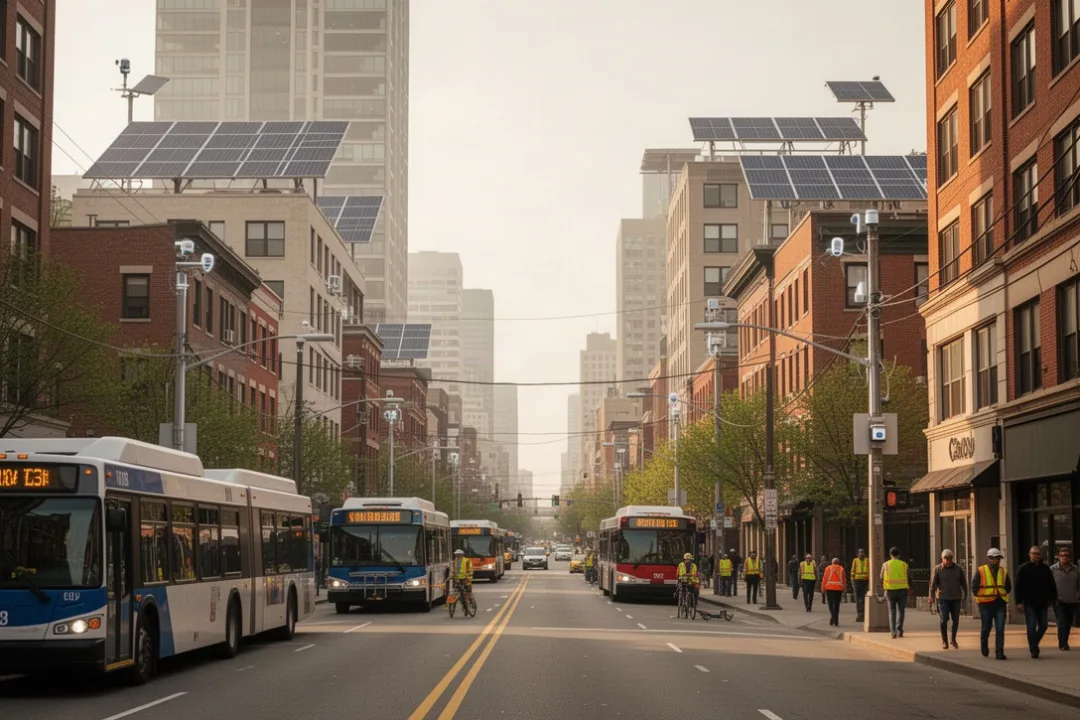
City of AI usually describes a city that uses artificial intelligence across public services, transportation, energy, safety, planning, and resident support. It can refer to a broad urban development model, a technology program, or the name of a specific project; it is not one universally recognized city with a single official definition.
The central idea is simple: data from roads, buildings, utilities, public agencies, and residents helps software identify patterns and support decisions. A responsible City of AI still depends on human judgment, public oversight, clear rules, and reliable services. AI may help a city operate more effectively, but it does not replace elected leaders, public workers, or community participation.
A City of AI is an urban ecosystem supported by artificial intelligence. Rather than using one app or one robot, it connects many systems that already exist in a city. Traffic cameras may provide information about congestion, utility meters may show changes in energy demand, and service records may reveal where repairs are needed most often.
AI systems process this information to make predictions, classify requests, detect unusual conditions, or recommend actions. For example, a transportation department might use historical traffic patterns and current road conditions to adjust signal timing. A water department might analyze pressure data to identify a possible leak before it causes major damage.
The phrase can describe several different things:
A citywide strategy: a government plan for using AI in departments such as transit, housing, health, utilities, and emergency response.
A planned development: a new district designed around connected infrastructure, autonomous systems, and digital services from the beginning.
A research or demonstration project: a test environment where companies, universities, or public agencies evaluate urban AI tools.
A marketing term: a label used to present a technology-focused real estate or smart-city project.
That range makes the term easy to misunderstand. A city can have advanced AI in one department without being an AI city in any meaningful citywide sense. Conversely, a city may use AI in the background without advertising itself with that label.
Important distinction: A smart city collects and connects information; a City of AI uses machine-learning or other AI systems to interpret information, make predictions, or automate parts of a decision. The two ideas overlap, but they are not identical.
How artificial intelligence supports city operations
AI is useful in cities because urban systems generate large amounts of information and change continuously. Human teams can review reports and make decisions, but they may struggle to examine millions of data points quickly. AI can identify relationships that are difficult to see manually, although its recommendations still need testing and supervision.
Several types of AI may appear in an urban setting. Predictive models estimate what may happen next, such as demand for buses or the likelihood of equipment failure. Computer vision analyzes images or video to identify objects, traffic conditions, damaged infrastructure, or safety hazards. Natural-language systems help residents ask questions, translate information, summarize documents, or submit service requests.
Other systems optimize complicated operations. An energy-management platform may balance supply and demand across buildings. A routing system may suggest how to deploy maintenance crews. A city planning tool may compare the possible effects of different street designs, zoning choices, or development patterns.
The quality of these systems depends on more than the algorithm. Useful results require accurate data, well-maintained sensors, trained staff, secure software, and a clear purpose. If the underlying information is incomplete or biased, an apparently sophisticated system can produce unreliable or unfair recommendations.
Where a City of AI can affect daily life
Transportation and street management
Transportation is one of the most visible uses of urban AI. Traffic systems can combine information about vehicle flow, transit schedules, construction, weather, and crashes to identify congestion and recommend changes. Transit agencies can use demand forecasts to plan service, improve transfers, or alert riders to disruptions.
AI may also support adaptive traffic signals that respond to changing traffic volumes instead of following a fixed schedule. Parking systems can estimate space availability, while maintenance programs can prioritize roads based on surface conditions and expected deterioration. These tools can reduce delays, but they must be designed carefully so that optimizing vehicle flow does not make walking, cycling, or public transportation less safe.
Autonomous vehicles are often associated with a City of AI, but they are only one possible element. A city does not need self-driving cars to use AI for transportation. In many communities, better bus planning, safer intersections, and quicker pothole repairs may deliver more practical value than highly visible autonomous technology.
Utilities, buildings, and energy
Buildings and utilities produce continuous streams of operational data. AI can examine energy use, equipment performance, weather conditions, and occupancy patterns to help reduce waste. A building-management system may recommend heating or cooling adjustments, identify an inefficient unit, or detect a gradual change that signals a maintenance problem.
Water providers can use analytical tools to study consumption, pressure, and flow. These systems may help locate leaks, forecast demand, and plan infrastructure upgrades. Electric utilities can use similar techniques to manage peak demand and coordinate distributed energy resources.
These applications can lower operating costs and support climate goals, but savings are not automatic. Sensors need calibration, equipment needs maintenance, and residents need understandable information about how their data is used. A system that saves energy by making homes uncomfortable or restricting service without adequate safeguards is not a successful public solution.
Public safety and emergency response
Emergency agencies may use AI to organize incoming reports, estimate resource needs, and identify patterns in calls for service. During a storm or other large event, software can help officials combine information from weather forecasts, road conditions, shelter capacity, and utility outages.
There is a major difference between decision support and automated enforcement. A tool that helps dispatchers see which areas need assistance can be evaluated differently from a system that predicts which individuals might commit wrongdoing. Facial recognition, location tracking, and predictive policing raise significant concerns about privacy, accuracy, due process, and unequal impacts.
Public safety systems should therefore include strict limits, independent testing, human review, and a way for people to challenge harmful decisions. More data does not automatically create more safety. In some situations, collecting less information and protecting it better is the more responsible choice.
Health, accessibility, and social services
AI can help public agencies manage appointments, identify gaps in service, translate communications, and connect residents with resources. It may support accessibility by generating captions, converting information into different formats, or helping people interact with government websites using natural language.
Health-related applications require particular caution. A model that prioritizes outreach or identifies a possible public-health trend should be checked by qualified professionals. Residents should know when an automated tool is involved, what information it uses, and how to request human assistance.
Social services also involve sensitive personal circumstances. An algorithm should not quietly determine who receives essential support based on incomplete records or historical patterns. Human caseworkers, clear eligibility standards, appeal rights, and privacy protections remain necessary.
Planning, housing, and public works
Urban planners can use AI to compare development scenarios, estimate travel demand, map heat exposure, and identify areas with limited access to parks or services. The technology may help staff examine more alternatives before making a recommendation.
AI can also assist with inspections and maintenance. Image analysis may help locate cracks in bridges, damaged signs, blocked drains, or sidewalk problems. A city can then combine those findings with safety risks, repair costs, and resident reports to set priorities.
Planning tools should not be treated as neutral simply because they produce maps or scores. Historical housing and infrastructure data may reflect past discrimination, uneven investment, or underreporting in communities with less access to government services. A model can reproduce those patterns unless officials deliberately test for them and correct the process.
What infrastructure a City of AI needs
AI depends on a foundation that residents may never see. A city needs dependable connectivity, secure data systems, computing capacity, trained employees, and processes for maintaining equipment. It also needs the authority and budget to operate systems after a pilot project ends.
Common components include:
Sensors and data sources: traffic counters, weather stations, utility meters, service requests, building systems, and other lawful sources of information.
Communications networks: reliable connections that move information between devices, agencies, and approved software platforms.
Data governance: rules for collection, storage, access, retention, quality, and deletion.
Computing and software: systems that store information, run models, monitor performance, and provide results to staff or residents.
Human expertise: public employees, engineers, privacy specialists, community representatives, and independent reviewers.
Interoperability matters as much as technology. If departments cannot exchange information safely, the city may accumulate isolated systems that are expensive to maintain. Open standards and clear contracts can reduce dependence on a single vendor and make it easier to replace an underperforming tool.
Data quality deserves special attention. A sensor may fail, a database may contain duplicate records, or one neighborhood may submit far more service requests than another because residents have better internet access. These differences can distort an AI system’s view of what is happening across the city.
Potential benefits of an AI-enabled city
The strongest case for urban AI is not novelty. It is the possibility of making public services more responsive, efficient, and accessible. When used for a well-defined purpose, AI can help employees process information faster and focus their time on complex work that requires judgment and direct contact with residents.
Potential benefits include:
Earlier problem detection: agencies may identify leaks, equipment failures, traffic hazards, or infrastructure damage before they become larger problems.
Better resource allocation: forecasts can help departments schedule crews, vehicles, inspections, and emergency supplies.
More convenient services: residents may receive faster answers, clearer forms, translation support, and simpler ways to report issues.
Lower operating waste: energy and water systems may use resources more efficiently when demand can be estimated accurately.
Improved planning: officials can compare several scenarios and examine possible effects before approving a project.
Greater accessibility: speech, translation, captioning, and alternative interfaces can make government services easier to use.
Benefits should be measured in terms residents can understand. A department might track response time, repair completion, transit reliability, energy consumption, or the number of people successfully served. A high model-accuracy score does not prove that a city improved if service quality, fairness, or public trust declined.
Risks involving privacy, fairness, and accountability
A City of AI can create new risks when public agencies collect information at a large scale. Cameras, mobile devices, license-plate readers, payment systems, and online portals can reveal where people go, when they travel, and which services they use. Even when individual records are separated from names, combining datasets may make people identifiable.
Purpose limitation is one useful safeguard. Information collected to manage traffic should not automatically be reused for unrelated surveillance. Agencies should explain what they collect, why they collect it, how long they keep it, and who can access it.
Fairness is another central concern. AI models learn from historical data, and historical decisions may contain unequal treatment. A system used to prioritize inspections, allocate services, or assess risk can therefore produce different results for different communities. Testing should examine performance across relevant groups, not only the average result.
Accountability becomes difficult when officials cannot explain why a system produced a recommendation. A vendor may describe its software as proprietary, but public agencies still need enough information to evaluate accuracy, limitations, security, and potential harm. Procurement contracts should provide audit rights, incident reporting duties, and access to documentation.
Residents also need a practical way to challenge an automated decision. A notice that simply says “the system determined” is not an adequate explanation when housing, benefits, mobility, employment, or public safety is affected. Human review should be available for high-impact decisions.
Practical rule: The more an AI system can affect a person’s rights, safety, finances, or access to essential services, the stronger the requirements for transparency, human review, testing, documentation, and appeal.
How to tell a genuine City of AI from a marketing label
The term can sound impressive without providing much information. A credible project should clearly state the problem it is solving, the agencies involved, the data being used, and the outcomes it expects. It should also explain what the system cannot do.
Look for evidence such as a public policy, procurement document, pilot evaluation, privacy impact assessment, security plan, or independent performance review. A project that only promises a futuristic experience but does not identify measurable goals deserves careful scrutiny.
Useful questions include:
What specific public problem is the AI system intended to address?
What information does it collect, and is each data source necessary?
Who owns the data, the model, and the results?
Can residents opt out where appropriate or request human assistance?
How is the system tested for errors and unequal impacts?
What happens when the software is wrong or unavailable?
Can the city end the contract and retrieve its data in a usable format?
Are residents, workers, and affected communities involved before deployment?
A real City of AI is not defined by the number of sensors or the amount of automation. It is defined by whether technology improves a public outcome while preserving rights, accountability, resilience, and human control.
Practical tips and common mistakes when evaluating an AI city project
If you are comparing cities, researching a proposed development, or reviewing a technology plan, focus on how the system works rather than on futuristic language. The following steps can help you assess both value and risk.
Define the service problem first. Ask what residents currently struggle with and whether a simpler process, better staffing, or improved infrastructure could solve it without AI.
Identify the decision being supported. Find out whether the system offers a recommendation, automates a routine task, or makes a high-impact decision about a person.
Check the data source. Look for gaps, outdated records, unequal coverage, duplicate entries, and information collected for a different purpose.
Ask how success is measured. Require practical measures such as shorter delays, fewer outages, safer crossings, or improved access—not vague claims about innovation.
Review human oversight. Confirm who can override the system, investigate an error, and help residents who disagree with an outcome.
Examine privacy and security controls. Check retention periods, access permissions, encryption, breach procedures, and rules for sharing information.
Look for an exit plan. A city should be able to suspend, replace, or remove a system without losing essential records or becoming dependent on one supplier.
Common mistakes include buying technology before defining the problem, treating a pilot as proof of long-term success, and measuring only technical accuracy. Cities can also overlook operating costs, staff training, cybersecurity updates, accessibility, and the people who lack reliable internet access.
Another mistake is assuming that a public dashboard automatically creates transparency. Publishing a model’s output without explaining its purpose, limitations, and consequences may confuse residents rather than inform them. Good transparency is understandable, timely, and connected to a real opportunity for public feedback.
How residents can participate in a City of AI
Residents are not merely data sources or users of automated services. They are the people affected by the choices a city makes. Public meetings, advisory groups, surveys, community organizations, and accessible feedback channels can help identify problems that technical teams may miss.
Participation works best when it happens before a system is purchased or deployed. Residents should be able to ask what information will be collected, which communities may be affected, and what protections will apply. Meetings should include plain-language explanations rather than requiring technical knowledge.
People can also ask local officials for records about AI systems. Depending on local rules, useful documents may include contracts, policies, impact assessments, audits, training materials, and performance reports. Community groups can compare the stated purpose of a system with its actual effects and request changes when results are harmful.
Access must be preserved for people who do not use smartphones, broadband, online portals, or automated chat tools. A city that moves every service into an AI interface may create a new barrier instead of improving access. Phone, in-person, paper, and human-assisted options remain valuable.
What a responsible future for Cities of AI looks like
Responsible urban AI will likely be less about replacing public institutions and more about helping them work with better information. The most valuable systems may operate quietly in the background: predicting equipment failures, making government forms easier to understand, or helping workers respond to service requests more consistently.
Future projects should emphasize privacy-preserving design, secure data sharing, explainable processes, and independent evaluation. Cities may also need common standards so that systems from different departments can communicate without creating unnecessary surveillance or vendor lock-in.
Human skills will remain essential. Public employees must understand enough about AI to question its recommendations, recognize errors, and explain its use to residents. Communities need meaningful authority over high-impact applications, not just an opportunity to comment after a decision has already been made.
The best measure of a City of AI is therefore not how advanced it appears. It is whether people receive dependable services, whether public resources are used fairly, and whether residents can understand and challenge decisions that affect them. Artificial intelligence can support those goals, but only when the city places public interest ahead of automation for its own sake.
Frequently asked questions
Is City of AI a real city?
“City of AI” is generally not the official name of one universally recognized city. It is usually a broad term for an urban area that uses artificial intelligence in transportation, utilities, planning, public services, or safety. Some technology programs and planned developments may use the phrase as a brand, so the exact meaning depends on the project being discussed.
What is the difference between a smart city and a City of AI?
A smart city uses connected technology, sensors, software, and data to manage urban services. A City of AI emphasizes artificial intelligence that analyzes information, predicts conditions, recognizes patterns, or supports decisions. Many smart cities use AI, but connected infrastructure alone does not necessarily make a city AI-enabled.
How does AI help cities?
AI can forecast transit demand, identify infrastructure problems, improve energy efficiency, organize service requests, support emergency planning, and make government information easier to access. Its value depends on accurate data, trained staff, security, and human oversight. AI should support clearly defined public goals rather than being adopted simply because it is new.
What are the main dangers of an AI city?
Major concerns include excessive surveillance, data breaches, biased outcomes, unclear automated decisions, vendor dependence, and reduced access for people who cannot use digital services. These risks are especially serious when AI affects housing, benefits, policing, health, or other essential services. Privacy limits, audits, human review, appeal rights, and public participation can reduce harm.











Leave a Reply