Bible Story with Talking Donkey: Balaam and the Donkey’s Message
The tale of Balaam and his donkey is one of the most striking episodes in the Old Testament that features a talking animal delivering a divine message. This narrative, usually anchored in the Book of Numbers, blends prophecy, obedience, and a dramatic confrontation with a heavenly messenger. It invites readers to listen closely to the ways God intervenes in human plans and to consider the meaning of faithfulness in moments of pressure, power, and temptation. In this article we explore the story from multiple angles, highlighting its main events, spiritual themes, and how later readers have interpreted the remarkable moment when a donkey speaks to a man who cannot at first hear the message of God.
Although the core arc is widely known—the prophet Balaam sets out to curse Israel and is checked by a talking donkey—the narrative also invites broader reflections on prophecy, divine sovereignty, and human perception. By examining variations of the telling, the literary devices at work, and the practical lessons for contemporary readers, we can gain a richer understanding of this biblical story with a talking donkey and its enduring relevance.
Context and Characters in the Balaam Narrative
To understand the moment when a beast speaks, it helps to know the principal actors in this Bible story:
Balaam: a non-Israelite prophet known for his oracles, who is sought by rulers for his blessing or curse over peoples.
Balak: the king of Moab who seeks to bend outcomes in his favor through Balaam’s prophetic word.
The donkey: Balaam’s stubborn beast, which becomes the unlikely vehicle for a message from God.
The angel of the Lord: a heavenly being who stands in the path to block Balaam’s purposes, visible only to the donkey and later opened to Balaam’s perception.
God (Yahweh): the sovereign authority who directs the course of events and shapes the content of prophecy.
The setting is a tense intersection of political intrigue and religious expectation. Balaam is summoned by Balak to pronounce curses over the Israelites, a people whom Balak fears and envies. In the ancient Near East, prophets could be courted as instruments to sway fate and fortune. Yet this is not a simple tale of a man and a magical animal; it is a narrative about accountability before a transcendent God who controls speech, path, and outcome.
The Request to Curse Israel: An Appetite for Power Meets Divine Will
The core conflict begins with a request that seems audacious in light of the wealth at stake and the risk to national security. Balak believes that if Balaam could pronounce a curse over Israel, his army would be defeated and his own power would be secure. The exchange unfolds with international implications and a test of loyalty to God’s plan.
Balak sends honorable gifts and invitations to Balaam, hoping to secure a prophetic instrument capable of turning military fortune.
Balaam consults with God and is told not to go with the men, but the invitation grows stronger, and the offer of wealth becomes increasingly tempting.
Before Balaam makes a final decision, God reiterates a crucial constraint: you may not pronounce a curse on this people; what your mouth speaks must align with what I declare.
The tension between ambition and obedience is a recurring theme in biblical narratives, and the Balaam episode probes that tension in a vivid, memorable way. The narrative frames the journey not as a mere adventure but as a test of discernment—will Balaam follow the divine instruction, or will he be swayed by human incentives?
The Donkey’s Intervention: The Donkey Speaks, and Everything Changes
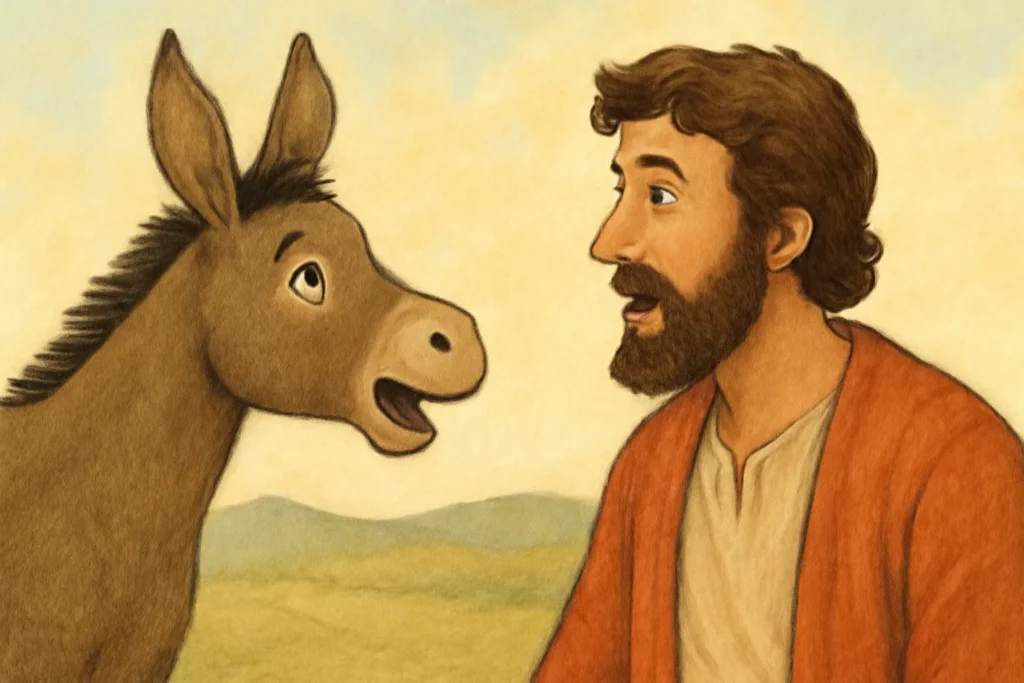
The most famous moment in this bible story with a talking donkey comes when Balaam’s donkey unexpectedly speaks. The sequence unfolds with a drama that transcends cultural expectations about animals, prophecy, and obedience.
The First Sign: The Path Obstructed
As Balaam travels toward Balak’s destination, his donkey suddenly turns aside from the road. The path is narrow, and the donkey’s action blocks Balaam’s advance. Balaam strikes the donkey, insisting that it continue. This moment foreshadows the deeper issue: Balaam is not merely moving along a physical route; he is moving along a moral and spiritual road that may be blocked by divine intention.
The donkey’s behavior alarms the reader because the animal seems to perceive danger that the human guardian does not. In the narrative logic, the donkey’s action functions as a moral sensor, a reminder that human plans are not autonomous when they collide with the hidden purposes of God.
The journey continues, and the donkey veers again, this time into a field. When Balaam strikes the donkey again, the creature presses forward and speaks in a human voice, asking why Balaam has beaten him. This is the first moment when the reader hears that something truly extraordinary is happening: a beast is addressing a prophet with rhetorical clarity, and the prophet responds with frustration rather than recognition.
The dialogue here is a turning point. The donkey’s appeal—asking whether Balaam has ever ridden with the donkey before—draws Balaam into a moment of self-examination: the prophet may be missing a crucial truth because he is too focused on his own goals to notice divine signs.
The Third Sign: The Wall and the Sword
The final obstacle appears as a narrow place where a wall closes in on the road. The donkey again refuses passage, and Balaam, angry, begins to beat it. Then, in a transformative moment, God opens Balaam’s eyes and allows him to see the angel of the Lord standing in the way with a drawn sword.
The donkey’s courage, coupled with a dramatic shift in perception, becomes the fulcrum of the entire encounter. The animal has already saved Balaam from disaster by refusing to move forward; now Balaam himself is confronted with the reality that he is under watchful divine scrutiny. The angel delivers a powerful message: the road Balaam has chosen, though illuminated by prophetic authority and political gain, is perilous and perishable if it diverges from God’s will.
This trio of signs—the road blocked, the field redirected, and the narrow pass guarded by the angel—constitutes a triptych moment in the narrative. It dramatizes a principle: divine guidance can surface in unexpected voices, and true discernment requires humility to listen, even when the source of the warning comes from an unlikely messenger.
The Angel and the Word: A Lesson on Divine Authority
After Balaam’s eyes are opened, the angel of the Lord explains the prohibition and sets the terms for the rest of the encounter. The angel’s words affirm that, while Balaam has permission to speak, he must do so only as God directs. This moment elevates the narrative from a single incident of a talking animal to a broader meditation on the nature of prophetic authority.
The angel’s message clarifies that prophecy is subject to divine sovereignty, not human whim or political calculation.
Balaam learns that he cannot manipulate outcomes by speeches alone; his words must align with God’s intention for Israel and for the surrounding nations.
The king’s fortune and Balaam’s reputation both depend on fidelity to what God says, not on what Balak wishes to hear.
The episode is often read as a reminder that voices—whether of prophets, kings, or talking animals—are instruments in a larger divine plan. The donkey’s unexpected speech becomes a catalyst for Balaam’s own conversion in that moment: a humility-based listening that precedes the blessings Balaam pronounces over Israel.
Balaam’s Oracles: From Curse to Blessing
The most famous outcome of this narrative is Balaam’s shifting message. Religiously, the oracles that Balaam delivers on Balak’s request quickly become one of the most striking features of the story. Instead of curses, Balaam pronounces blessings that reflect a higher order of judgment and mercy. The transformation from a mercenary prophet seeking wealth to a mouthpiece that declares God’s favorable will underscores a powerful theme in biblical literature: true prophecy is not merely about predicting outcomes but about aligning human speech with divine purpose.
Blessings over Israel: Balaam’s oracles reinforce Israel’s special status in God’s plan, despite external opposition.
Shunning of Balak’s schemes: The prophetic words reveal the emptiness of political manipulation when it contradicts God’s will.
The event also foreshadows later biblical motifs: the idea that human intentions cannot override divine intention, and that divine protection can be a source of strength for a people who are under threat.
The narrative’s outcome emphasizes that even a perceived breakthrough for worldly power cannot override the divine purposes for a people chosen by God. Balaam’s final messages, filled with divine wisdom rather than political calculation, illustrate a paradox: a prophet who wanted to profit from the situation ends up delivering a truth that has lasting spiritual resonance for generations.
Thematic Reflections: Lessons from the Donkey and the Prophet
The Balaam story with the talking donkey is widely used in teaching to unpack several enduring themes. The following reflections highlight how readers have interpreted the tale across time and context.
Divine sovereignty versus human ambition: God’s purposes prevail even when a prophet seeks personal gain.
Perception versus reality: the donkey sees dangers that the human misses; spiritual sight often differs from ordinary perception.
Prophetic humility: true prophecy requires listening before speaking and alignment with God’s word rather than human expectations.
Communication across voices: a talking animal becomes a bridge for a divine message, illustrating that God can use unlikely channels to convey truth.
The narrative can thus be read as a comprehensive instruction in ethics for leaders, prophets, and readers who seek to understand how to navigate power, persuasion, and purpose with integrity.
While the event of Balaam’s talking donkey stands as a singular episode in the biblical record, scholars and storytellers often talk about it in various ways to broaden its semantic reach. Here are some common variations and interpretive angles that help expand the semantic breadth of the tale.
The donkey as moral compass: The donkey serves as a moral sensor that reveals Balaam’s inner state and the hidden dangers ahead.
Human speech as a test of listening: The moment when the donkey speaks invites readers to consider who is truly listening and who is open to instruction beyond conventional channels.
Prophecy under constraint: The idea that prophecy is not about gratuitous power but about obedience to divine instruction, even under pressure.
Angelic confrontation as literary device: The angel appears to block the path and then speaks through the messenger of God, blending the dramatic and the theological to heighten the sense of sacred encounter.
Some modern retellings and devotional readings emphasize alternate phrasing and translations—“the ass” versus “the donkey,” and “speaks” versus “declares”—to foreground different interpretive angles while preserving the core message: true authority in prophetic speech is anchored in God’s will.
Beyond its ancient setting, the Balaam narrative offers a framework for contemporary readers who wrestle with conflicting loyalties, the lure of wealth, and the difficulty of remaining faithful to a larger purpose. Several practical takeaways emerge from the donkey’s message and Balaam’s experience.
Listen for divine signals: God’s guidance can appear in unexpected ways, requiring humility, discernment, and willingness to change course when necessary.
Seek alignment with God’s plan: Wealth, prestige, and influence should not override the higher calling of obedience to God’s purposes for community and justice.
Recognize limits of personal judgment: The story warns against assuming that one’s own path is flawless simply because it seems successful or secure.
Respect prophetic integrity: A prophet’s authority depends on fidelity to God’s message, even when that message challenges status quo or personal ambition.
In the end, the talking donkey’s intervention is less about an animal performing a miracle and more about a divine insistence: we must pay attention when the path ahead is dangerous or misaligned with God’s will. The donkey stands as a symbolic witness that the road to wisdom often requires listening to voices we expect least to speak into our lives.
The Balaam narrative sits within a wider biblical interest in how God communicates and how humans respond. While the talking donkey is a rare and dramatic instance, the Bible includes several motifs that illuminate how God uses voices, signs, and signs that interrupt ordinary life to deliver truth.
Voice and revelation: Prophets often begin with a perceived weakness or a surprising messenger, which then becomes a conduit for divine communication.
Obedience under pressure: Faithfulness is tested when resources are at stake, and true fidelity often requires choosing God’s word over personal gain.
Humility before the divine: The narrative invites readers to acknowledge that human understanding is limited and that spiritual sight requires divine assistance.
The story’s themes resonate across scripture and have been used in sermons, Bible studies, and literary retellings to explore how God challenges assumptions, reshapes expectations, and directs speech toward outcomes that honor the divine will.
For contemporary audiences, the Balaam and the talking donkey story offers several practical applications that can inform personal conduct and community ethics.
Ethics in leadership: Leaders are urged to measure their decisions against a higher moral horizon rather than solely political or financial incentives.
Discernment in discernible signs: When signs point toward harm or misalignment with God’s purposes, the faithful are called to reconsider or redirect their plans.
Humility and openness: The donkey’s courage to speak, in effect, invites humility—recognizing that wisdom can come from unlikely sources and that one’s own perspective may be limited.
Prophetic responsibility: Those who speak for others, especially in religious or civic contexts, bear responsibility for the effects of their words, ensuring they align with truth and justice.
In sum, this Bible story with a talking donkey remains a powerful reminder that authority and influence demand accountability before God. It also models how listening, even when uncomfortable, can avert catastrophe and redirect steps toward blessings rather than curses.
The Balaam episode, culminating in a talking donkey and a transformed prophetic message, challenges readers to consider the source of authority, the posture of the prophet, and the ultimate sovereignty of God. The donkey’s speech might be seen as a dramatic device, but its effect is real: it compels Balaam to confront the difference between human aspiration and divine instruction. The message that Balaam finally proclaims—blessings over Israel and, more broadly, a reminder that God’s purposes prevail—offers a practical and theological takeaway for readers today: truth, entrusted to human voices, must always be measured against the character and will of the Creator.
Whether you approach this narrative as a historical account, a literary parable, or a devotional meditation, the core truth remains clear: God’s plan endures, and the true prophet is the one who speaks in alignment with that plan, even when it contradicts personal ambitions. The donkey’s message—to listen, to question, and to submit to divine instruction—continues to speak to audiences who seek wisdom in a complex world.
For readers who want to explore further, consider reading the accounts of Numbers 22–24 in different Bible translations, noting how language shapes perception of the miracle and the prophetic voice. Look for other moments in scripture where divine messages come through unlikely channels, and reflect on how these passages invite humility, justice, and faithful witness in daily life.








Leave a Reply