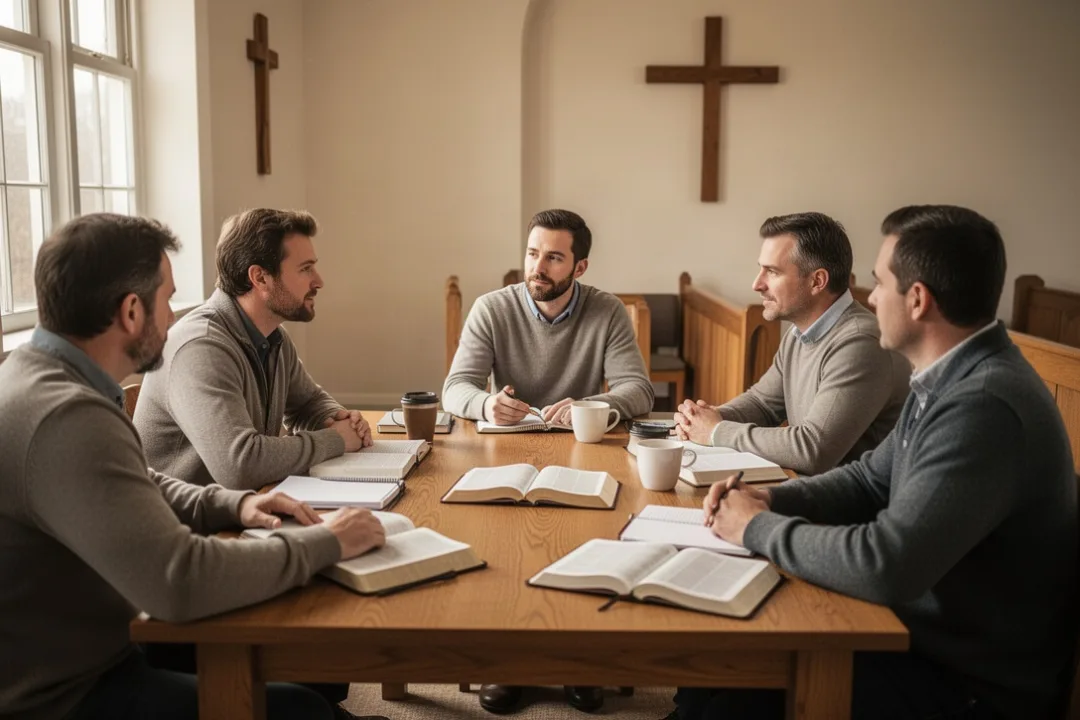
Men’s Bible studies can take many forms. A group may meet in a church classroom, a home, a coffee shop, or online. It may include longtime Christians, men who are exploring faith, or participants with very different experiences of church. The setting matters less than the group’s shared commitment to open Scripture and respond honestly.
A useful study is more than a weekly conversation about religious ideas. It gives men room to ask difficult questions, examine their choices, receive wise encouragement, and connect biblical truth with work, marriage, friendship, parenting, suffering, and service. The goal is not to create the most impressive discussion. The goal is faithful understanding that leads to faithful action.
Before choosing a book or study guide, decide what you want the group to become. You might be trying to establish a regular habit of reading the Bible, help new believers learn basic Christian beliefs, strengthen a church community, or give men a trustworthy place to discuss personal challenges. A clear purpose prevents meetings from becoming unfocused or dominated by a few confident speakers.
Central principle: Read the Bible carefully, listen to one another respectfully, and connect every meeting with a practical response.
How to start a men’s Bible study step by step
You do not need a complicated program to begin. A dependable meeting time, a manageable passage, and a few men willing to participate are enough. These steps can help you build a group that is welcoming and sustainable.
Define the purpose. Write one sentence describing what the group hopes to do. For example, “We will study a Gospel together and encourage one another to follow Jesus in everyday life.”
Choose the right size. Four to twelve participants often makes it easier for everyone to speak. A larger group may work well if you divide into smaller discussion circles.
Set a consistent schedule. Weekly or every-other-week meetings usually provide enough continuity without creating unnecessary pressure. Choose a time that fits the men you hope to include.
Select a biblical book or focused topic. Studying one book of the Bible often gives the group better continuity than jumping between unrelated subjects.
Decide where and how to meet. A comfortable, accessible location reduces excuses and helps new participants feel at ease. Online meetings can work when travel or work schedules make in-person gatherings difficult.
Explain expectations before the first meeting. Tell participants how long the meeting will last, what they should read, and how the group will handle confidentiality and disagreement.
Prepare questions in advance. Use questions that move from observation to interpretation and then application. Avoid preparing so many questions that the group has no time to think.
End with a specific next step. Invite each man to identify one action, prayer, conversation, or attitude he will carry into the week.
Starting small can be an advantage. A group does not need a polished identity, a special curriculum, or a large launch event. A simple first gathering can reveal what participants need and help you adjust the format before inviting more men.
How to choose a passage or study topic
The best selection matches the group’s experience, season of life, and spiritual needs. If most participants are new to Bible study, a shorter Gospel passage may be more accessible than a complex prophetic book. If the group already reads Scripture regularly, studying a difficult letter or a major biblical theme may provide a worthwhile challenge.
Studying a whole biblical book has several strengths. Participants see how individual passages fit into a larger argument, notice repeated themes, and develop a habit of reading context. Books such as Mark, Philippians, James, Ephesians, and 1 Peter offer material for discussing identity, endurance, relationships, integrity, service, and hope. The right choice depends on the group rather than on a universal ranking of books.
A topical study can also serve a real purpose. You might explore prayer, temptation, wisdom, leadership, forgiveness, work, fatherhood, grief, or Christian community. When choosing a topic, make sure the group studies the actual biblical passages behind the theme instead of relying only on personal opinions or a popular author’s conclusions.
For learning how to read the Bible: choose a short book and study it passage by passage.
For men facing a shared life season: select passages related to marriage, parenting, work, aging, loss, or transition.
For foundational Christian formation: study Jesus’ identity, the cross, resurrection, prayer, discipleship, and the church.
For a group with varied backgrounds: choose passages that provide clear context and avoid assuming extensive Bible knowledge.
For deeper study: work through a book with attention to structure, historical setting, literary style, and connections to the rest of Scripture.
Resist choosing a topic only because it sounds relevant. A good study asks what the biblical text actually says, what it meant in its original setting, and how its truth should shape Christian life now. Relevance grows from careful reading rather than from forcing a passage to answer every modern concern.
A practical 60-minute meeting format
A predictable structure helps men participate without making the gathering feel rigid. The following format can be adapted for a breakfast meeting, an evening group, or a video call.
Welcome and connection: 10 minutes. Greet one another and invite a brief check-in. Keep this portion warm but focused so that personal conversation does not consume the study.
Opening prayer: 5 minutes. Ask God for humility, understanding, honesty, and the ability to apply what the group learns.
Read the passage: 10 minutes. Read it aloud, perhaps in more than one translation, or ask participants to read selected paragraphs. Notice repeated words, contrasts, commands, promises, and changes in setting.
Discuss the meaning: 20 minutes. Ask what the passage says, how its parts relate, and what questions or tensions it raises. Encourage participants to use the text rather than drifting immediately to personal stories.
Apply the message: 10 minutes. Consider how the passage addresses attitudes, decisions, relationships, habits, and responsibilities during the coming week.
Pray for one another: 5 minutes. Keep requests as private as needed and give men an opportunity to pray in ways that feel comfortable.
The exact minutes are less important than the balance. If a group spends all its time socializing, it may never engage Scripture. If it spends every minute analyzing details, participants may leave without considering how to live differently. A healthy meeting combines friendship, biblical understanding, personal honesty, and prayer.
Questions that lead to better Bible discussion
Questions shape the culture of a group. Questions that are too easy produce short answers, while questions that are overly personal can make men withdraw. Begin with the passage itself, move toward meaning, and then invite application at an appropriate level.
Observation questions identify what the passage says
Ask participants to pay attention before they offer an interpretation. Useful questions include: Who is present? What happens first? What changes? Which words or ideas are repeated? What commands, warnings, promises, or examples appear? What does the passage reveal about God, people, sin, faith, suffering, or obedience?
Observation is not a lesser form of study. It protects the group from making the text say whatever the first speaker wants it to say. It also gives quieter participants a concrete way to join the conversation.
Interpretation questions explore the passage’s meaning
Once the group knows what it sees, ask why the details matter. How does the surrounding chapter shape this passage? What problem is being addressed? What response does the writer seek? How would the original audience have understood the situation? Are there words or cultural details that require further research?
When a question cannot be answered confidently from the passage, say so. The group can consult a trustworthy study Bible, commentary, pastor, or other reliable resource. Honest uncertainty is healthier than confident speculation.
Application questions connect Scripture with real life
Application should be specific enough to guide a decision. Ask: What belief needs to change? What habit needs attention? Where do you need courage, patience, confession, or forgiveness? How might this passage affect the way you treat a spouse, child, coworker, friend, neighbor, or church member?
Do not assume every application must be dramatic. A man may need to apologize, make a truthful decision at work, set aside time for prayer, seek counsel, or stop hiding a problem. Small acts of obedience can reveal whether a group is actually responding to Scripture.
How to create honest and respectful conversation
Many men are comfortable discussing sports, work, or practical problems but less comfortable discussing fear, shame, grief, temptation, or spiritual doubt. A leader cannot force vulnerability, but he can make it safer by modeling humility and refusing to use another person’s disclosure as a future illustration or joke.
Set simple ground rules at the beginning. Participants should listen without interrupting, avoid trying to fix every problem, and keep personal matters confidential except when someone faces an immediate danger or requires appropriate help. Confidentiality should not be used to conceal abuse, threats, or situations that require professional or pastoral intervention.
Make room for every voice. Invite quieter members into the conversation without putting them on the spot.
Limit monopolizing. Thank frequent speakers for their contribution and ask what others are noticing.
Separate disagreement from disrespect. Men can hold different interpretations while still treating one another with care.
Do not reward performance. The person with the most Bible knowledge should not control the group.
Protect personal stories. Do not repeat someone’s disclosure outside the group without permission.
Refer serious concerns wisely. A Bible study is not a substitute for medical, mental health, legal, or pastoral care.
Leaders should be especially careful when discussing marriage, sexuality, addiction, money, anger, or family conflict. These subjects can expose vulnerable people and may involve situations that require trained support. The group can pray and encourage, but it should not pretend that discussion alone solves every problem.
Leadership reminder: Never promise absolute secrecy if someone may be in danger. Protect privacy while taking serious safety concerns to the right pastor, professional, or authority.
How to lead without turning the group into a lecture
A leader’s job is to prepare the environment, guide the discussion, and keep the group close to the biblical text. It is not to provide every answer or demonstrate superior knowledge. Strong leaders ask good questions, listen carefully, correct errors gently, and admit when they need to investigate something further.
Prepare by reading the passage several times. Note the main idea, unfamiliar terms, significant connections, and questions that may arise. Consult reliable resources when necessary, but do not bury the group beneath technical details. Choose a few essential questions and allow enough silence for participants to think before answering.
If a discussion wanders, bring it back with a clear transition: “How do we see that in this passage?” or “What does the text give us for that conclusion?” If a participant shares a personal problem, acknowledge it before returning to the study. A response such as “Thank you for trusting us with that; what part of the passage speaks to your situation?” can connect pastoral care with biblical reflection.
When correcting an interpretation, focus on the idea rather than embarrassing the person. You might say, “That is one possibility. What details in the passage support it?” This approach encourages careful thinking while preserving the participant’s dignity.
How to keep the group centered on Jesus and Scripture
Christian Bible study should not become a collection of self-improvement lessons. The Bible addresses conduct, but it also reveals God’s character, human need, redemption, and the work of Jesus Christ. Ask how the passage fits within the larger story of Scripture and what kind of response it calls forth from those who trust God.
That does not mean forcing a reference to Jesus into every sentence. It means reading passages in context and recognizing the relationship between biblical teaching and the gospel. In the Gospels, pay attention to Jesus’ actions, authority, compassion, conflict, death, and resurrection. In the letters, consider how instruction flows from what God has done through Christ. In wisdom literature, explore how reverence for God shapes ordinary decisions.
A Christ-centered study also avoids reducing discipleship to private morality. Following Jesus involves love of neighbor, service, justice, generosity, reconciliation, care for the vulnerable, and participation in a worshiping community. Men should leave with a fuller vision of faith, not merely a list of personal rules.
Ways to connect Bible study with everyday life
Application becomes stronger when it names a real setting. Instead of asking only, “What did you learn?” ask how the passage might influence a difficult conversation, a financial decision, a workplace conflict, a parenting response, or an unseen habit. Concrete questions help participants recognize that biblical formation happens throughout the week.
At work: How will truthfulness, diligence, humility, or fairness shape your next decision?
At home: What would patient listening, confession, or sacrificial service look like in your household?
In friendships: Who needs encouragement, accountability, forgiveness, or an honest conversation?
Under pressure: Which promise or command can guide you when you feel angry, afraid, tempted, or exhausted?
In the church: Where can you serve rather than remain a passive observer?
In private habits: What recurring pattern needs prayer, boundaries, confession, or outside support?
Invite men to choose one response rather than making an unrealistic list. At the next meeting, ask whether anyone noticed a change or faced an obstacle. Follow-up turns application from a closing thought into an ongoing practice.
How to include men with different backgrounds
A mixed group can be spiritually fruitful when participants treat differences as a reason to listen rather than compete. Men may vary in age, denomination, family situation, education, ethnicity, political perspective, Bible knowledge, and church experience. Those differences can broaden understanding, but they can also create tension if the group assumes everyone uses the same vocabulary or shares the same conclusions.
Explain unfamiliar Christian terms when they arise. Do not treat questions as evidence of weak faith. A man who is investigating Christianity should be able to say what he does not understand without being pressured to imitate the language of longtime church members.
Keep the group anchored in the passage and distinguish essential Christian convictions from secondary disagreements. If a disputed issue takes over the meeting, acknowledge its importance and decide whether it deserves a separate conversation. A group that never disagrees is not necessarily healthy, but a group that turns every disagreement into a contest will eventually lose trust.
How to use books, videos, and study guides wisely
Additional resources can clarify historical background, explain literary structure, and offer helpful questions. They should serve Scripture rather than replace it. Read the biblical passage first, discuss what you observe, and then use the resource to test or expand the group’s understanding.
Check the author’s purpose and perspective before adopting a study guide. Consider whether the material handles the Bible responsibly, represents opposing views fairly, and fits the spiritual maturity of the group. A resource designed for individual devotion may not work well for a discussion group, and a highly academic commentary may overwhelm men who are still learning basic study habits.
Videos can be useful when they provide clear teaching, but they should not reduce the participants to an audience. If a video takes twenty minutes of a one-hour meeting, reserve time for men to examine the passage and discuss how the material applies. Conversation and prayer are part of the study, not optional extras after the teaching is finished.
How to handle prayer in a men’s Bible study
Prayer should reflect the passage and the needs of the people present. A group might praise God for a truth revealed in Scripture, confess a shared weakness, ask for wisdom, intercede for family members, or pray for strength to obey. Keep prayer accessible so that men who are less experienced do not feel they must use polished language.
Some groups prefer an open prayer circle, while others ask one or two men to pray. Both approaches can work. Never measure spiritual maturity by how long or publicly a man prays. A brief, sincere prayer can be more appropriate than an extended speech.
Be sensitive to requests involving health, marriage, addiction, grief, or financial strain. Ask permission before sharing someone’s situation with people outside the group. When a need exceeds the group’s ability to respond, help the person connect with a pastor, counselor, doctor, support group, or other qualified source of care.
How to sustain participation over time
Consistency matters more than novelty. Men are more likely to keep attending when meetings begin and end on time, the reading load is manageable, and the group remembers personal details from one week to the next. Rotate small responsibilities such as reading the passage, opening in prayer, bringing refreshments, or preparing a background question.
Communicate clearly when the schedule changes. If attendance drops, ask what barriers are affecting participation rather than assuming a lack of commitment. Work demands, childcare, transportation, illness, and family responsibilities may require practical adjustments. A group can remain serious about Scripture without becoming careless about people’s limits.
Periodically review the group’s direction. Ask whether participants are learning to read the Bible more carefully, growing in trust, praying for one another, and practicing what they discuss. If the answer is no, change the format. You may need shorter passages, better questions, a different meeting time, smaller groups, or a clearer purpose.
A healthy men’s Bible study does not depend on one charismatic leader or one popular resource. It grows through regular Scripture, honest relationships, prayer, accountability, and obedient action. Start with a passage, invite a few men, and build the kind of trust that allows biblical truth to reach ordinary life.
Frequently asked questions
What book of the Bible is best for a men’s Bible study?
There is no single best choice for every group. Mark offers a focused account of Jesus’ ministry, James connects faith with practical conduct, Philippians explores joy and humility, and Ephesians addresses identity and community. Choose a book that matches the participants’ experience, available time, and main purpose rather than selecting one only because it is popular.
How many men should be in a Bible study group?
A group of four to twelve men often provides a good balance between variety and participation. Smaller groups allow deeper personal conversation, while larger groups may offer more perspectives but require stronger facilitation. If attendance regularly exceeds twelve, consider dividing into discussion circles while gathering together for teaching or prayer.
Should a men’s Bible study use a published curriculum?
A curriculum can save preparation time and provide helpful structure, but it is not required. The group can study a biblical book using the passage, observation questions, interpretation questions, and application questions. If you use outside material, let it support direct engagement with Scripture rather than replacing the group’s reading and discussion.
What should a leader do when a Bible study becomes argumentative?
Reestablish the group’s purpose and return to the passage. Ask participants to explain their interpretations from the text, distinguish central beliefs from secondary issues, and speak respectfully. If one topic repeatedly creates conflict, set it aside for a separate conversation or seek guidance from a pastor. Protecting trust is more important than winning a debate.










Leave a Reply