The topic of Daniel prophecy and Jesus sits at the crossroads of biblical
narrative, prophetic literature, and early Christian interpretation. In many Christian
traditions, Danielic prophecy is read as foretelling the coming Messiah —
the promised Anointed One who would establish a kingdom that endures forever.
In Jewish understanding, on the other hand, the prophet Daniel is often read within a historical
frame, emphasizing faithful response to oppression and the eventual vindication of God’s people.
This article surveys the major Daniel prophecy strands that Christians have
historically connected to Jesus, while also noting the distinct but important Jewish
interpretations. It is not a capsule of the entire debate, but a careful, biblically anchored
survey of the most influential passages — particularly Daniel 2, Daniel 7, Daniel 9, and the broader arc of Daniel 11–12 — and how
they relate to the testimony about the Messiah.
Throughout this article you will see terms such as Stone, Son of Man, and Seventy Weeks highlighted as markers for central ideas in the Daniel prophecy tradition and its connection to the life, mission, and death of Jesus.
The goal is to explain not only what the passages say in their own contexts, but how they
shaped later theological interpretation and how readers today might weigh evidence from
scripture, history, and scholarship.
Daniel 2: The dream of kingdoms and the stone that conquers all
Context and imagery
In Daniel 2, the kingship dream given to Nebuchadnezzar presents a statue composed
of successive materials: gold, silver, bronze, iron, and clay. This imagery is widely understood as a
symbol of successive world empires that rise and fall in human history. The turning point in the
chapter is not the statue itself but the appearance of a stone that strikes the statue,
becomes a great mountain, and fills the earth.
Within classic Christian interpretation, this stone is often read as a symbol of the kingdom of God,
established by the coming Messiah. In this reading, the Daniel prophecy about a divine
intervention culminates in a heavenly, eternal kingdom that supersedes earthly kingdoms. The
phrase “the Stone struck the statue” is read as a pointer to a divine initiative mediated
through the Anointed One, who inaugurates a lasting rule.
Jesus, the stone, and the kingdom language
Christian readers often identify Daniel 2 with the person and work of Jesus in two
interlocking ways:
The Messiah embodies the coming kingdom of God, not by seizing earthly power but
by establishing a spiritual and eternal reign that begins in the present age and expands to
future fullness.
The stone imagery aligns with New Testament portrayals of Jesus as the foundation stone on which
God builds his people (echoing Old Testament motifs and the gospel narratives that present Jesus
as fulfilling prophetic expectations).
This linkage—Daniel prophecy about a divine intervention that centralizes God’s reign through
a chosen servant—helps many readers understand how Jesus embodies the culminated plan
announced in Daniel 2.
Daniel 7: The Ancient of Days, the Son of Man, and divine sovereignty
Beasts, the court scene, and the end of oppression
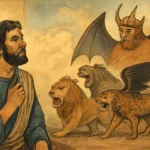
Daniel 7 moves from statue imagery to a vision of four beasts rising from the sea, representing
successive powers. A central figure called the “one like a Son of Man” appears and is
given dominion, glory, and an everlasting kingdom. The scene culminates with the Ancient of Days
taking his seat in judgment, and the Son of Man receiving universal authority.
The key interpretive move in Christian tradition is to understand the Son of Man as Jesus
himself, connecting the Danielic figure to his earthly ministry, passion, and post-resurrection
exaltation. This is reflected in the Gospels, where Jesus frequently uses the title Son of Man to
describe his own mission. The Danielic vision thus becomes a framework for
understanding Jesus’ identity as the ruler who conquers not through violence but through
fidelity to God and the establishment of a divine kingdom.
Interpretive nuances and tensions
Some scholars emphasize that the immediate context of Daniel 7 concerns the historical
persecution and political upheavals during the late Jewish era under foreign powers. From this
vantage point, the Son of Man figure is primarily a symbol of righteous vindication and
divine sovereignty in the face of oppression. Christian readers, however, have tended to
read the passage in light of the life of Jesus, identifying the eternal kingdom with the
messianic activity attributed to him in the New Testament.
The phrase “the throne and dominion” in Daniel 7 thus becomes a bridge between
prophetic literature and gospel narratives. It invites readers to explore how Danielic prophecy informs
expectations about who the Messiah is and how God will exercise rule over human
history.
Daniel 9: The Seventy Weeks, the Anointed One, and timeline expectations
Context: Daniel’s prayer and God’s response
In Daniel 9, the prophet prays for his people, and the heavenly messenger reveals a plan
tied to a determining period: seventy weeks. This timeline has become one of the central
pieces in debates about how prophecy interfaces with history and the coming Messiah.
The text speaks of completion, sin atonement, and the vindication of the holy city, with a particular emphasis
on an Anointed One who will be cut off and will bring an end to sacrifice and offering. The
precise interpretation of the timeline has been the subject of centuries of scholarly and devotional
study, with Christian readers often associating the segments of weeks with chronological markers
spanning from the Cyrus decree to the advent and work of Jesus.
The “Anointed One,” the cut off, and implications for the Messiah
The phrase “the Anointed One” (often translated as Messiah or Christ)
in Daniel 9 is central to discussions about the Daniel prophecy and its
connection to Jesus’ mission. In Christian readings, this figure is closely linked
to the life and death of Jesus, who is portrayed in the New Testament as fulfilling the
prophesied sacrifice and inaugurating the new covenant.
A common outline used by preachers and scholars when explaining Daniel 9 is as follows:
The decree to rebuild Jerusalem marks the starting point of the timeline.
The first “weeks” correspond to periods of political and religious activity in the Jewish community.
The “Anointed One” who is cut off points to a pivotal moment in salvation history.
The subsequent events describe a period of turmoil before the eventual establishment of God’s purposes.
The interpretive challenge lies in harmonizing the historical details with a theological exegesis that
sees Jesus as the culmination of the prophecy. For some readers, the timeline is primarily
historical; for others, it has eschatological significance that points toward the return of the Messiah.
Daniel 11–12: Proclamations, conflicts, and the shifting horizon of the Messiah
Historical frame and prophetic breadth
The chapters Daniel 11 and Daniel 12 contain intricate prophecies about various kings
of the north and south, political intrigues, and cycles of oppression and deliverance. The text moves
through a succession of empires and political actors, often in a level of specificity that has intrigued
scholars for centuries.
Within Danielic prophecy, some readers see foreshadowings of ultimate eschatological events, while
others interpret the material as focusing on the immediate historical context of the Jewish people
under foreign dominion. Yet even among divergent interpretations, many observe a through-line:
God remains sovereign over human history, and his purposes involve the vindication of the righteous
and the establishment of a lasting order under the leadership of the Messiah.
How the Danielic voice interacts with the idea of the Messiah
In these chapters, the expectation of a divinely appointed deliverer continues to appear, though the
exact identification of this figure varies. For Christians, these chapters are often read as
anticipations of Jesus’ ministry, death, and resurrection, with the Son of Man motif acting
as a bridge to the gospel portrayal of Jesus as the one who ultimately executes God’s plan.
It is important to acknowledge that the Danielic passages are complex and multi-layered. The
specificity of the political landscape is sometimes read as a historical map; others see in it a
template for future events. Both lines of interpretation, however, share a confidence that God
will intervene decisively on behalf of his people and will crown justice with mercy through the
work of the Messiah.
New Testament connections: how the Daniel prophecy informs Jesus’ identity and mission
Fulfillment motifs in the Gospels
The New Testament writers often frame Jesus’ life and mission against the backdrop of Danielic prophecy.
They suggest that Jesus fulfills the expectations associated with the Messiah and the language of
the Son of Man found in Daniel 7. The gospel narratives depict Jesus’ authority,
suffering, and exaltation in a way that many readers hear as the culmination of the divine drama
described in the Danielic corpus.
Early Christian interpretation and church tradition
Early Christians read Daniel prophecy as a framework within which Jesus’ life was interpreted:
his teaching, miracles, crucifixion, and resurrection were seen as the climactic realization of the
Messiah’s work foretold in Daniel 2, Daniel 7, and Daniel 9.
This interpretive approach shaped the creeds, sermons, and biblical exegesis of the church
throughout antiquity and into the modern period.
Jewish and interfaith perspectives
From a Jewish perspective, the Daniel prophecy retains its own historical and
literary integrity, often focusing on Daniel’s faithfulness under oppression and God’s
sovereignty rather than on a Christian Christological reading. In interfaith dialogue and
scholarly work, interpreters emphasize comparing the different readings—historical, messianic,
and eschatological—so readers better understand how a single biblical book can bear
multiple, meaningful interpretations.
Key themes across the Daniel prophecy and Jesus
God’s sovereignty over kingdoms
Across the Danielic corpus, a central motif is the supremacy of God over earthly powers. In Daniel 2, the divine stone topples the statue of human empires; in Daniel 7, the
Ancient of Days rules with the Son of Man receiving an eternal kingdom. This overarching claim—God’s
ultimate sovereignty—frames how readers interpret the life and mission of Jesus within the
larger narrative of salvation history.
Righteous suffering and vindication
Several Danielic strands emphasize that the righteous will endure suffering but will be vindicated
by God. When linked to Jesus, this motif resonates with the passion narrative and the
resurrection, which Christians interpret as the climactic vindication of God’s plan through the
Messiah’s obedience unto death.
Temple, sacrifice, and covenant continuity
The themes of temple, sacrifice, and covenant appear in both Daniel and the broader biblical witness. Daniel 9’s discussion of atonement and the end of sacrifices, for instance, intersects with
gospel accounts that present Jesus as the once-for-all sacrifice who establishes the new covenant.
Readers often encounter a harmony between the prophetic expectation in Daniel prophecy and
the New Testament portrayal of Jesus’ redemptive work.
Practical questions often asked about Daniel prophecy and Jesus
Is Daniel’s prophecy about Jesus a universal claim or a particular historical claim?
Many readers recognize a dual dynamic: the prophecies have historical specificity in their own
context, yet they also carry universal (eschatological) significance that Christians interpret
as pointing to the universal scope of God’s redemptive plan in Christ. The degree to which one sees
these passages as fulfilled in the first advent of Jesus or as pointing forward to a future
culmination depends on theological method and hermeneutical assumptions.
What about the timeline in Daniel 9—does it reliably predict dates?
The discussion of timelines, including the Seventy Weeks, invites careful exegesis and
historical context. Some Christian scholars attempt to align the timeline with known historical events
around the life of Jesus, while others emphasize the symbolic or prophetic significance rather
than precise calendrical dating. The important point for readers is to understand that the timeline
serves to communicate divine purpose rather than to function as a precise algebraic forecast.
If you are approaching the topic of Daniel prophecy and Jesus for the first time, you may
find it helpful to approach the material with a few practical steps:
Read the primary texts in Daniel (2, 7, 9, 11–12) in a reliable translation and with
a focus on the immediate literary context.
Compare the Danielic images with their New Testament counterparts to see how the
authors interpret the events in Jesus’ life.
Note how various traditions interpret the same passages—this will broaden your understanding of
how Daniel prophecy has shaped Christian and Jewish thought.
Reading plan for deeper understanding
Study Daniel 2 to appreciate the kingdom motif and the idea of a divine intervention.
Explore Daniel 7 to understand the Son of Man motif and universal sovereignty.
Examine Daniel 9 for the timeline framework and its theological implications.
Survey Daniel 11–12 for the broader worldview of prophetic imagery and eschatology.
Consult diverse commentaries to see how historians and theologians handle difficult verses.
Common misconceptions to avoid
When engaging with the subject of Daniel prophecy and Jesus, some misunderstandings recur:
That all Daniel passages are straightforward predictions of Jesus in every detail — instead, many
passages require careful interpretation within their literary context.
That the Christian reading is the only legitimate interpretation — there are longstanding Jewish
and secular readings that emphasize different emphases.
That prophecy is purely deterministic — many scholars highlight the interpretive flexibility
of prophetic symbolism and its capacity to point toward multiple horizons across time.
Conclusion: What the Daniel prophecy teaches about the Messiah and about Jesus
Across the passages of Daniel, the biblical witness preserves a compelling claim:
God is sovereign over history, and he will bring the earth’s history to its intended end under the
leadership of the Messiah. For many readers, this is best understood as a shared
Hebrew-Christian narrative about the coming of Jesus, who, in the Christian view,
embodies the fulfillment of Danielic prophecy through his life, death, resurrection, and
the establishment of God’s kingdom.
At the same time, it is essential to recognize the broader interpretive landscape: Daniel prophecy has been read in a variety of ways across time and traditions. The
conversations between Christian and Jewish readings, as well as between different Christian
denominations, reveal a robust scholarly and devotional engagement with Daniel as a book
that continues to shape how believers understand the nature of God, the meaning of Messiah, and the mission of Jesus.
In studying the question of Daniel prophecy and Jesus, readers gain not only a set of
answers about a single Messiah but also a pathway to consider the character of biblical prophecy:
how God speaks into history, how his promises unfold across centuries, and how readers today can
honor the integrity of the text while engaging with a living faith tradition.