Chords for Amazing Grace: Easy Guitar Chords, Tutorial, and Song Sheet
Chords for Amazing Grace: Easy Guitar Chords, Tutorial, and Song Sheet
If you’re learning Amazing Grace on guitar, you’re joining a tradition that blends simple melody with timeless emotion. This article is a comprehensive guide to chords for Amazing Grace, focusing on easy guitar chords, practical tutorials, and a ready-to-use song sheet you can print or save. Whether you’re a complete beginner or you’re brushing up on a few stock progressions, you’ll find practical, structured advice here that helps you play with confidence, musicality, and faith-inspired expression.
Amazing Grace is widely performed in a variety of keys to accommodate different vocal ranges and guitar tunings. The song’s core progressions are intentionally simple, often built from a handful of common open chords and occasionally supplemented by a barre chord or two as you gain nuance or shift keys. In this article, you’ll encounter:
Key options that work well for guitarists at different levels, including G major, D major, C major, and related minor/relative shapes.
Ways to transpose the song using a capo, so you can keep the familiar shapes while singing in a different key.
Detailed descriptions of chord families (open chords, common barre shapes, and pull-offs to embellish the melody) that keep the arrangement approachable.
Structured progressions that you’ll see in many traditional renderings, plus modern variations for singers or guitarists who want a slightly more contemporary feel.
The term chords for Amazing Grace can be used in a few senses: the specific shapes you play, the way you voice the chords, and the cadence that supports the melody. This article addresses all three, with practical examples and variations so you can customize the accompaniment to your voice, tempo, and mood.
Common key choices and chord sets
The most approachable versions for beginners typically revolve around open chords in a single key. As you grow comfortable, you can expand to barre chords for a fuller rhythm or experiment with capo transpositions to fit the vocal line without changing the chord shapes.
G major: a classic, friendly starting point
In the key of G major, you’ll usually encounter these chords:
G, D, Em, C, sometimes Am and Dsus2 for color.
Common, friendly shapes: G major (open), D major (open), Em (open), C major (open).
The typical open-chord set in G major supports the traditional Amazing Grace progression: G – D – Em – C. You may see variations like G – D – C – G, or a brief run through Em to create a gentle minor color before returning to the major key. Using G major as the baseline makes strumming intuitive for most players, and the open shapes are forgiving for beginners, with clear, ringing tones.
For players who prefer a different resonance or need to transpose for a higher vocal range, D major is another strong candidate. In D major, you’ll commonly use:
D, A, Bm (barre or simplified), G, and F#m (as a barre chord or F#m7 variant).
One straightforward approach is to play in D major with D – A – Bm – G, which maintains a bright, ringing sound that suits a hymn-like tempo.
If you’re new to barre chords, you can use a capo to stay in open-chord shapes while shifting the key. For example, placing a capo on the 2nd fret allows you to play the familiar G-shaped chords as if in A major, providing a slightly brighter timbre without changing fingerings.
C major and the relative minor option
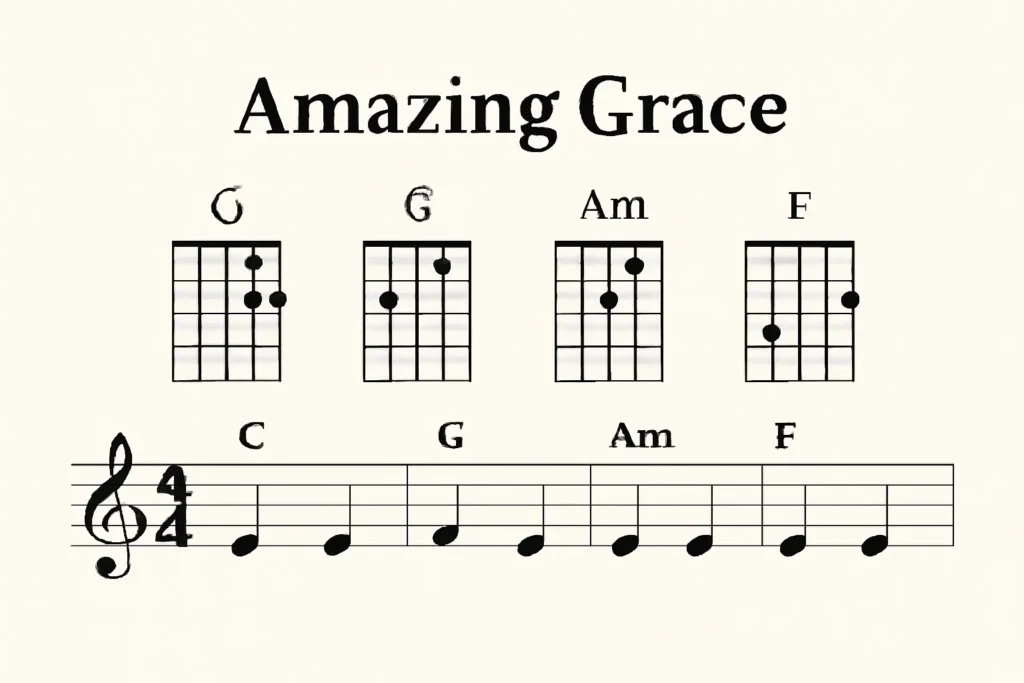
In C major, the commonly used shapes include:
C, G, Am, F (often Fmaj7 or simplified F), and Dm.
Progressions such as C – G – Am – F or C – G – F – C are frequently heard in gentle, intimate renditions of the hymn.
The relative minor option adds color without complicating fingering. For example, applying Am instead of Em gives a softer, more contemplative character, especially in verses that lean toward introspection. You’ll still resolve back to the major chord to bring the arrangement home.
Open chords and easy shapes
If you’re building a durable skill set, start with open chords because they require less pressure and offer immediate resonance. Here are some practical open-chord shapes and tips to get you moving fast.
G major (open)
Finger positions: 2nd fret on A string, 3rd fret on E low string, ring finger on 3rd fret of low E (E) string, etc. In plain terms, the standard G shape is comfortable for many players.
Sound and use: Provides a bright, robust foundation for Amazing Grace in most traditional keys.
D major (open)
Finger positions: 2nd fret on G string, 2nd fret on high E string, 3rd fret on B string (or a simplified D variant you prefer).
Sound and use: When used in combination with A and G or Bm, it creates a smooth, uplifting cadence that supports clear vocal lines.
Em and C major (open)
Em is often used as a brief color in the verse to prepare for returning to G or D; C provides a warm, consonant support beneath the melody.
Finger positions: Em is open; C uses three fingers arranged across the A, D, and B strings.
Am and Dm as color tones
Am and Dm can substitute Em or C to create a gentle minor flavor.
These shapes encourage smoother voice-leading between chords and help you avoid abrupt changes in tempo or mood.
Chord progressions for Amazing Grace: traditional and new takes
The heart of Amazing Grace rests on simple, memorable progressions that support a clear melody. Below you’ll find several reputable progressions grouped by approach, so you can pick a baseline and then customize it to your voice, tempo, and arrangement.
Traditional progressions in G major
G – D – Em – C (I – V – vi – IV) — This is perhaps the most familiar streaming of the tune in many church and school settings. It creates a smooth, comforting lift as the phrase begins and ends.
G – D – C – G (I – V – IV – I) — A more compact cadence suitable for verse-to-verse transitions with a simple resolution.
G – Em – C – D – G (I – vi – IV – V – I) — Adds a gentle walk through the relative minor before the final return to the tonic.
Transposing with capos: stay in open shapes
Capo on the 2nd fret and play G-shaped chords to effectively sing in A major while keeping familiar fingerings.
Capo on the 3rd fret with C-shaped shapes yields E-flat major-like voicings that can brighten or darken the mood depending on tempo and vocal range.
Capo on the 4th fret with D-shaped shapes gives you F# major tones while remaining comfortable for players who prefer open-chord ergonomics.
Movable shapes and general guidance
Use Em as a transitional color between major chords to soften the cadence and prepare for the return to the tonic.
Explore Am and Dm substitutions in the verses to evoke a quiet, reflective mood before the final, triumphant resolution.
Experiment with adding a passing chord like Fmaj7 (instead of F or Fmaj7) for a smoother, jazzier color that still fits the hymn’s tempo.
Tutorial: rhythm, strumming, and nuanced playing
A practical tutorial helps you translate these chords into a compelling performance. The goal is to maintain the hymn’s integrity—its reverent, steady pulse—while allowing for personal expression. Below are actionable techniques that work well across keys and chord sets.
Rhythm and timing basics
Most traditional renditions of Amazing Grace are felt in a gentle 3/4 time or a refined 6/8 feel. If you’re practicing with a metronome, start at a slow tempo (around 60–72 BPM) and count “1-2-3” per measure, letting the melody breathe on beat 2 or 3 as suits the verse.
Focus on even, clean chord changes. Start with the simplest progression (G – D – Em – C) and ensure each chord rings cleanly before adding rhythm.
Strumming patterns for a hymn-like feel
Basic down-stroke on every beat (1-2-3-4) works for a 4/4 feel but can be adapted for 3/4 with a triadic emphasis on the first beat.
Classic gentle hymn pattern: D D U (Down-Down-Up) for each measure, with a light upstroke on beat 3 in 3/4 timing when the melody allows. This creates a warm, singable groove without overpowering the vocal line.
Alternate option for a fuller sound: Down-Down-Up-Up-Down-Up across each measure. This yields a more flowing accompaniment while preserving clarity of the melodies.
Fingerpicking and light arpeggios
Begin by picking the root note of each chord on the bass strings, then briefly arpeggiate the high strings to outline the harmony. This technique is especially effective in verses that are more introspective or when accompanying a solo vocal line.
Try a simple pattern like P-i-M-a for the right hand (thumb on low strings, index-middle-ring on the upper strings) to produce a restful, contemplative texture that suits the hymn’s mood.
As you practice, listen for balance between the rhythm and the vocal line. Your goal is to support the singer while maintaining a steady and comforting pulse. A good rule of thumb is to avoid over-strumming; let the chords ring to maximize resonance in acoustic settings or with a room’s natural reverb.
Song sheet: ready-to-use chorded lyrics for Amazing Grace
In this section you’ll find a concise, chorded lyric sheet you can copy into a notebook or print. The chords are placed above the corresponding words to guide your timing. If you’re using a capo, remember to adjust the chord names printed here or simply transpose mentally and keep the shapes the same.
Chords used: G, D, Em, C, Am, Fmaj7 (optional)
[G]Amazing Grace, how sweet the sound
[D]That saved a [G]wretch like [Em]me
[G]I once was [D]lost, but now I [G]found
[Em]Was blind, but now I [D]see
[G]’Twas grace that taught my [D]heart to fear
And [G]grace, my fears re[D]lieved
How [Em]precious did [D]that grace ap[G]pear
The [Em]hour I first [D]believed
[G]Through many dangers, toils, and [D]snares
I have [G]already come
[Em]’Tis grace has brought me [D]safe thus [G]far
And [D]grace will lead me [G]home
[G]The Lord has promised good to me
His [D]word my hope se[G]ever [Em]is
When [G]this flesh and life shall [D]fail
I shall possess with [G]renewed [D]grace
[G]When we’ve been there ten thousand [D]years
Bright [G]shining as the sun
We’ve [Em]no less days to [D]sing God’s [G]praise
Than when we’d first be[D]gun
Note: The chord letters above the lyrics indicate where to change chords. If you’re using a capo, the shapes remain the same; you’ll simply play the shapes in the new key, and the chords listed on the sheet will reflect the actual pitch you’re hearing.
Variations and semantic breadth: multiple ways to approach the same song
There are numerous valid interpretations of Amazing Grace on guitar. Below are some variations of chords and arrangements you can experiment with to broaden your musical vocabulary while staying faithful to the tune.
Bolder, brighter arrangements: use D and A in addition to the standard G–D–Em–C, and incorporate F# diminished or passing tones to garnish transitions without derailing the melody.
Moody, contemplative versions: lean on Em and Am in verses, with a subtle bass line and a restrained strum pattern, then move to a triumphant G major cadence at the chorus or final verse.
Capo-based transpositions: Capo on 2, 3, or 4 with G-shaped, C-shaped, or D-shaped chords keeps the shapes simple while letting you sing in keys better suited to your voice.
Fingerstyle adaptations: employ a gentle arpeggio pattern using the bass notes (G, D, Em, C) to give the piece a meditative, intimate feel for solo acoustic performances.
Alternative voicings: substitute Fmaj7 for F in certain measures to keep the tone open and less tense, which can be especially helpful for beginners building finger dexterity.
Common mistakes to avoid and practice tips
Even with simple chords, beginners sometimes stumble on transitions or rhythm. Here are practical tips to help you improve quickly and stay motivated.
Practice clean fretting: make sure each string rings clearly when you switch chords. Move slowly at first, then gradually increase tempo as accuracy improves.
Keep a steady tempo: use a metronome and subdivide the beat so you don’t drift into uneven timing as you sing or accompany a vocalist.
Avoid heavy-handed strumming: start with light, even strokes and only add volume as you gain control over rhythm and tone.
Voice leading matters: try to minimize chord changes that create awkward leaps. Use Em or Am as transitional chords to keep lines smooth.
Capo usage: experiment with capos to find the most comfortable range for your vocal range. Capo helps you keep the same fingerings while reaching different pitches.
Putting it all together: planning a practice session
A productive practice session blends technique with musicality. Here’s a suggested plan you can follow, especially if you’re new to guitar chords for Amazing Grace.
Warm-up: 5 minutes of finger stretches and basic open-chord transitions (G, C, D, Em).
Rhythm work: 5 minutes of the agreed strumming pattern or a light fingerstyle pattern, using a simple chord sequence (G – D – Em – C).
Chord color: 5 minutes experimenting with Am, Fmaj7, and Dm to see how they color the verse. Return to G for resolution.
Song sheet reading: read through the chorded lyrics slowly, marking where you will change chords in real time.
Performance attempt: 5–7 minutes of playing the verse and chorus together at a moderate tempo, focusing on tone and fluency.
As you progress, you’ll find your own preferred combinations. The harmonic backbone remains remarkably stable, but your personal touch—whether it’s a lighter strum, a subtle arpeggio, or a warmer tone—will make the arrangement yours.
Tips for teachers, learners, and choir leaders
If you’re guiding others through Amazing Grace, these practical ideas can help you structure lessons, rehearsals, and performances effectively.
For beginners: start with one or two chords per week and build to a full progression by week three. Use the spoken rhythm to help students feel the tempo before synchronizing with the melody.
For more advanced players: introduce capo variations and alternative voicings, then challenge students to improvise a micro-bridge using a short, tasteful melodic fill that fits the hymn’s mood.
For choirs and ensembles: assign different keys to different vocal ranges and use capos to align guitar parts with singers, ensuring that the accompaniment does not overpower the vocal line.
This guide emphasizes accessible chord theory and practical, hands-on practice. You don’t need to master every barre chord to play a meaningful rendition of Amazing Grace. Start with open chords, a reasonable tempo, and clear rhythm. As you gain confidence, gradually incorporate more diverse chords and strumming patterns to broaden your harmonic palette.
If you’d like extra practice materials, consider printable chord charts for G, D, Em, C, Am, and Fmaj7, plus a small library of common variations. A concise practice checklist can be useful: ensure smooth chord changes, verify each string rings clearly, and maintain a comfortable wrist position to prevent strain during longer practice sessions.
Glossary of key terms
Open chords: chords that use strings that aren’t blocked by the fretting hand and are playable with minimal finger pressure.
Barre chords: chords that require the index finger to press multiple strings across a fret, creating movable shapes that work across keys.
Capo: a device placed on a fret to raise the pitch of the open-chord shapes you’re playing, effectively transposing the key without changing fingerings.
Voice leading: the smooth movement of individual musical lines (voices) from one chord to another.
Root note: the fundamental note of a chord around which the harmony is built.










Leave a Reply