Bible concordance: how to find and study Scripture
Bible concordance: how to find and study Scripture
You remember part of a Bible verse but cannot recall where it appears. Perhaps you know a repeated word such as covenant, faith, or wisdom and want to find every related passage. A Bible concordance can help you locate those references quickly and study how a word is used across Scripture.
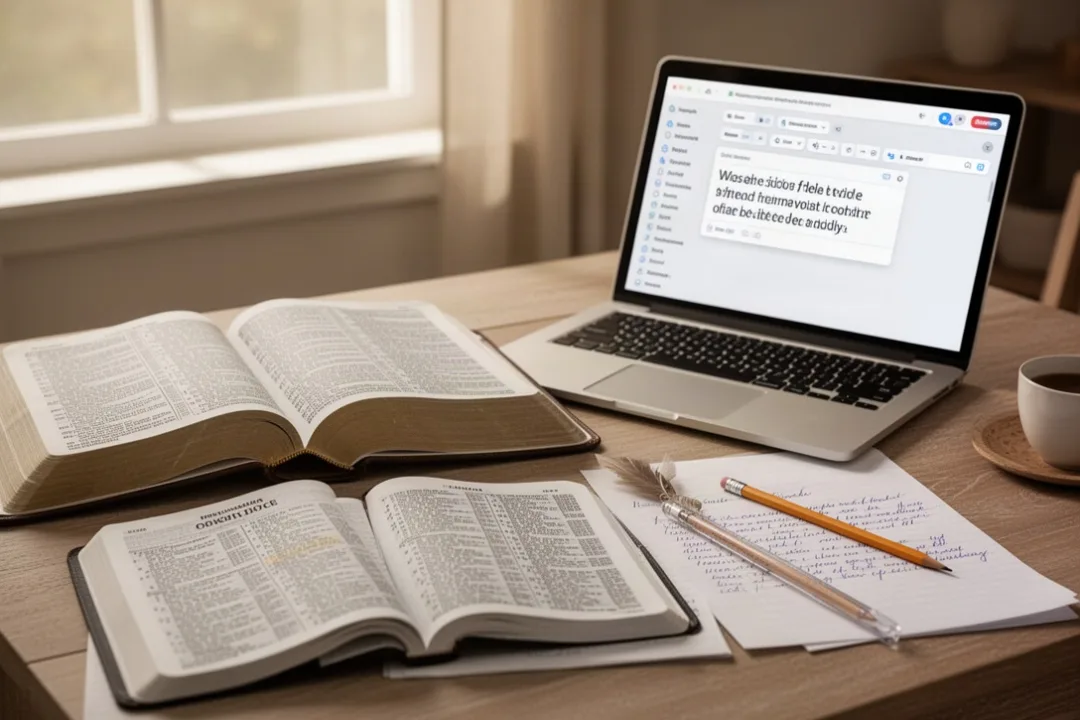
At its simplest, a concordance is an alphabetical index of words in the Bible, followed by references to the verses where those words appear. Many concordances also include a short portion of each verse, information about the original Hebrew or Greek term, and links to related entries. A print concordance works with a particular Bible translation, while an online concordance may search one or several translations.
The most useful way to think about a concordance is as a word-finding and comparison tool, not as a substitute for reading the Bible in context. It can show you where a term occurs, but careful interpretation still requires attention to the surrounding passage, the book’s purpose, the original audience, and the meaning of the word in that specific setting.
Core idea: A concordance helps you find passages by words. Context, literary setting, and sound interpretation help you understand those passages.
A traditional concordance is arranged by the words used in a specific translation. Under each entry, you may see several references and enough surrounding wording to recognize the verse. For example, looking up shepherd might lead you to passages in the Psalms, the Prophets, and the Gospels. The entries give you places to read; they do not automatically explain every meaning the word carries.
Many concordances include the most significant words in the biblical text rather than every short word. Common terms such as “the,” “and,” or “of” are often omitted because they would create enormous, unhelpful lists. Some resources include proper names, places, and variants, while others focus mainly on theological or descriptive vocabulary.
A concordance may present a reference in abbreviated form. “Matt. 5:3” refers to Matthew, chapter 5, verse 3. The abbreviations vary by resource, so check its list of book abbreviations if a reference is unfamiliar. When using an electronic tool, selecting the result usually opens the full passage in a Bible text.
Translation-based entries and original-language entries
A translation concordance lists the English words printed in a particular version. If you use a concordance based on the King James Version, for example, its entries will reflect the vocabulary and wording of that translation. A word that appears in one version may be translated differently in another, so the results will not always match.
An original-language concordance organizes information around Hebrew, Aramaic, or Greek words behind the English text. These resources can show that one English word represents several different original terms, or that one original term is translated with several English words. That distinction can be valuable, but it also requires caution because word meanings depend on usage, grammar, and context.
Some tools display a number beside an English word to connect it with an original-language entry. These numbers are commonly associated with Strong’s Concordance and are often called Strong’s numbers. They are useful for tracing words and locating lexical information, but the number itself is not a definition and should not be treated as a complete explanation of a biblical concept.
Why people use a Bible concordance
A concordance supports several kinds of Bible study. You might use it to locate a familiar verse, investigate a theme, compare passages, or examine how a writer uses a repeated term. The goal determines the best search strategy.
Finding a remembered verse: Search one or two distinctive words instead of a common word such as “God” or “Lord.”
Tracing a theme: Look up related terms and concepts, not just one exact word.
Studying a book: Examine repeated vocabulary within that book before comparing it with the rest of Scripture.
Comparing translations: Check whether different English versions use different words for the same passage.
Preparing to teach: Use the concordance to gather references, then read every passage in its larger setting.
Exploring an original term: Follow a Hebrew or Greek entry while consulting a reliable lexicon or study resource.
It is especially useful when your memory is incomplete. If you remember that a verse mentions “peace” and “mind,” searching either distinctive word may lead you to the passage. Once you find it, read beyond the single verse. A concordance gets you to the doorway; the surrounding text shows what the passage is actually saying.
How to use a Bible concordance step by step
1. Choose the right translation or search tool
Start by identifying the Bible version connected to your concordance. The wording of a remembered verse may differ because you heard it in church, read it in another translation, or recalled a paraphrase. If a print concordance does not locate the phrase, try a different translation or search for a distinctive idea rather than an exact wording.
Online tools often let you select a translation from a menu. Some allow searches across multiple versions, which is convenient for locating a passage. For close study, however, keep track of which translation produced each result so that you do not confuse one version’s wording with another’s.
2. Select a distinctive search word
Choose a word that is likely to narrow the results. A specific noun, place, image, or unusual verb is usually more helpful than a broad religious term. If you remember a phrase, search its most memorable word first, then add another term if the results are too numerous.
For example, if you are trying to find a passage about a lamp and feet, searching lamp may produce a manageable list. Searching God will likely return far more references than you can use efficiently. Once you find a likely passage, verify the wording in the full text rather than relying on the brief excerpt in the concordance.
3. Read the complete passage around each result
Do not treat an isolated line as the entire meaning. Read the paragraph, section, or chapter as appropriate. Ask who is speaking, who is being addressed, what problem or event is taking place, and how the surrounding sentences develop the point.
This step matters because the same English word can carry different meanings. Light may refer to physical illumination, moral behavior, divine revelation, or a metaphor for life. The concordance can collect those uses, but only the passage can show which sense applies in each case.
4. Record patterns without forcing them
As you examine the results, write down repeated ideas, contrasts, commands, promises, and settings. Notice whether the word appears mainly in narrative, poetry, prophecy, letters, or another type of writing. A repeated word may connect passages, but repetition alone does not prove that every reference makes the same theological point.
Compare passages carefully. Psalm 23 uses shepherd imagery in a poem of trust, while Jesus’ shepherd language in John 10 appears within a larger discussion of his relationship to his followers. The shared image invites comparison, but each passage still has its own author, setting, and emphasis.
5. Check related words and concepts
One English word rarely covers an entire biblical subject. A study of joy, for instance, may also benefit from searches for rejoicing, gladness, singing, celebration, sorrow, and hope. A study of justice may involve righteousness, judgment, mercy, oppression, the poor, and the stranger.
Use a concordance to build a collection of relevant passages, then group them by topic or book. This prevents a narrow search from making a complex theme appear simpler than it is. It also helps you notice passages that use different vocabulary to address the same concern.
6. Compare translations and consult supporting resources
Comparing several reputable translations can reveal wording differences that deserve further attention. If one version says servant and another says slave, for example, do not immediately decide that one is wrong. Examine the passage, its historical setting, and the range of meanings available in the original language.
A Bible dictionary can explain people, places, customs, and major themes. A commentary can discuss interpretation and historical context. A lexicon can provide information about an original-language word. These resources serve different purposes, so use them alongside the concordance rather than expecting one tool to do everything.
Practical habit: Write the translation, search word, references, and observations in your notes. This makes your study easier to review and helps you distinguish what the text says from your own conclusions.
How a concordance differs from related Bible study tools
Several resources look similar but answer different questions. Knowing the distinction helps you choose the right one instead of using a concordance for a task it was not designed to handle.
Concordance: Where does this word appear, and what passages contain it?
Bible dictionary: What does this biblical person, place, object, or concept mean?
Lexicon: What can be learned about a Hebrew, Aramaic, or Greek term, including its range of usage?
Commentary: How have interpreters explained this passage’s meaning, context, and difficulties?
Cross-reference system: Which other passages are connected by quotation, theme, image, or subject?
Topical index: Which references address a subject, even when they do not use the exact word you searched?
A concordance is usually strongest at locating repeated vocabulary. A topical index may be better when you want to study a subject expressed through many different words. A cross-reference system may lead you to related passages that a basic word search would miss altogether.
What original-language searches can and cannot tell you
Original-language tools can clarify why English translations differ. Hebrew and Greek words may have several possible meanings, and translators choose wording based on grammar and context. Seeing the underlying term can alert you to a meaningful connection that is less visible in English.
Still, a single Hebrew or Greek word does not always have one fixed English equivalent. Languages work through semantic ranges, meaning that a term may be used in several related ways. The surrounding sentence, the author’s style, and the type of literature all influence the appropriate meaning.
Be cautious with claims that a word’s “real meaning” can be discovered simply by listing every place where it occurs. That method can create a false blend of meanings. A word used in a legal instruction, a poem, and a letter may share a core association while functioning differently in each passage.
Original-language tools also do not remove the need for grammar. Verb tense, number, case, articles, prepositions, and sentence structure may affect interpretation. If a study depends heavily on those details, consult a reputable scholarly resource or a qualified teacher rather than relying on a number-coded lookup alone.
Common Bible concordance mistakes to avoid
A concordance is simple to operate, but careless use can lead to weak conclusions. The following habits will make your searches more reliable.
Searching only one English word: Related ideas may appear under different vocabulary, especially across translations.
Ignoring the translation: A print concordance may not match the Bible version you are reading.
Reading only the listed fragment: Short excerpts help you identify a verse but cannot replace the full context.
Treating every occurrence as identical: A word can have different senses in different passages.
Building doctrine from a word count: Frequency does not by itself determine importance or meaning.
Assuming a Strong’s number explains everything: Numbered entries identify terms but do not provide a full interpretation.
Ignoring genre: Poetry, narrative, wisdom writing, prophecy, and letters communicate in different ways.
Using only favorite passages: A balanced study includes relevant texts that may challenge your first impression.
Confusing association with quotation: Two passages may share a theme without one directly explaining the other.
Another common mistake is treating the concordance as a shortcut around careful reading. If a search produces dozens of references, you do not need to force all of them into one conclusion. Sort them by book, genre, speaker, audience, and context. Sometimes the most responsible result is a more limited claim.
Using an online Bible concordance effectively
Online concordances make searching fast. You can enter a word, phrase, or reference and often filter results by testament, book, translation, or original-language number. Many also connect search results with parallel translations, audio Bibles, dictionaries, and commentaries.
Begin with the simplest search. If you enter too many words, a site may miss the passage because the wording differs from your memory. If you receive too many results, add a second distinctive word or narrow the search to a particular book.
Pay attention to the search settings. A tool may search exact phrases, partial words, every word in a phrase, or only a selected translation. Some sites include footnotes, headings, or editorial material in their results. Check what is being searched before drawing conclusions from the number of matches.
Online tools are also useful for comparing a passage quickly. Read the same reference in several translations, then return to the translation used by your church, study group, or assignment. The comparison should raise thoughtful questions, not encourage you to choose whichever wording seems to support a preferred interpretation.
Keeping online study focused
Fast searching can create scattered study. To stay focused, begin with a clear question such as, “How does this book describe wisdom?” or “What happens before and after this promise?” Record the references that directly address that question and set aside interesting but unrelated links.
Limit the number of supporting tools open at once. A concordance, Bible text, dictionary, and one trusted commentary may be enough for a first pass. Too many tabs can shift your attention from the biblical passage to endless information gathering.
How to choose a print or digital concordance
Choose a resource based first on the Bible translation you use most often. A translation-specific concordance is convenient when you want to find wording exactly as it appears in that version. If you regularly compare translations, an online tool or a broader reference library may suit you better.
Consider the level of detail you need. A basic concordance is compact and practical for locating verses. An expanded concordance may include original-language numbers, pronunciation information, definitions, and additional references. More detail can be helpful, but it can also make the resource harder to use if you only need quick searches.
For occasional verse searches: Use a dependable online concordance or a concise print edition.
For topical study: Choose a resource with broad entries and cross-references.
For language study: Look for original-language information and pair it with a reliable lexicon.
For group study: Use a shared translation so everyone can follow the references easily.
For academic work: Verify editions, translation bases, and scholarly claims with established reference works.
Check who produced the resource and what text it uses. A well-known title can still reflect a particular theological tradition or an older understanding of language. The concordance is most trustworthy when you know its translation base, editorial method, and limits.
A practical example of concordance-based study
Suppose you want to study the biblical idea of rest. Begin by searching the word in your chosen translation and listing the references. Then read each passage in context and mark whether “rest” refers to sleep, relief from labor, peace after conflict, worship, trust, or a future hope.
Next, search related words such as cease, weary, peace, refresh, Sabbath, and burden. Some passages may address the same subject without using the exact word rest. Group your findings by literary setting and ask how the meaning changes from one context to another.
Finally, compare the central passages with a Bible dictionary or commentary. If a passage uses an important original-language term, consult a lexicon cautiously. Write a conclusion that reflects the evidence: identify the main patterns, acknowledge differences among passages, and avoid claiming that every reference means exactly the same thing.
This method works for almost any topic. The sequence remains steady: locate, read, compare, investigate, and apply carefully. The quality of the study comes less from the number of references collected than from the care used to understand them.
Using a concordance for personal study and teaching
For personal study, a concordance can help you move from a vague question to a focused reading plan. Write down the question before searching. After reviewing the passages, note what the text clearly states, what it suggests, and what remains uncertain.
For teaching, use the concordance during preparation rather than presenting a long list of references without explanation. Select passages that directly support the lesson’s purpose, read them in context, and explain why each one belongs. A few well-understood texts are more useful than a collection of disconnected verses.
When discussing a sensitive subject, include the full range of relevant evidence. Do not search only for words that confirm your existing position. A fair study may reveal several biblical emphases that need to be held together, such as truth and mercy, judgment and forgiveness, or individual responsibility and community care.
A concordance can also help with prayer and reflection when used thoughtfully. You might trace passages about gratitude, lament, patience, or hope, then read them as complete units rather than extracting isolated phrases. The tool serves the practice of attentive reading; it does not replace it.
Questions to ask after your concordance search
Before settling on an interpretation, pause over the results. These questions can expose gaps in your reasoning and keep the study connected to the actual text:
What does the word mean in this passage, and what evidence supports that meaning?
Who is speaking, writing, or acting, and who is receiving the message?
What comes immediately before and after the verse?
Does the passage use literal language, imagery, poetry, narrative, or instruction?
Are related terms present even if my chosen search word is absent?
Do other passages clarify the subject, or am I making one passage explain another too quickly?
Do translation differences affect the question I am asking?
What does the passage clearly say, and what am I inferring?
These questions turn a concordance search into a disciplined study process. They also help you recognize when you need a different resource, such as a commentary, historical background guide, or language reference.
Used with patience, a Bible concordance is one of the most practical tools for finding and comparing Scripture. It can rescue a half-remembered verse, reveal recurring language, and open a path into deeper study. Its proper role is straightforward: help you find the text so you can read, understand, and respond to it faithfully.
Frequently asked questions
Is a Bible concordance the same as a Bible dictionary?
No. A concordance indexes words and points you to the verses where they occur. A Bible dictionary explains people, places, objects, historical settings, and theological terms. You may use both together: the concordance finds the passages, while the dictionary supplies background that can help you understand them.
Can I use a concordance with any Bible translation?
A print concordance is usually tied to one specific translation, so its wording and results may not match another version. Online concordances often support several translations, but you should still confirm which version produced the search results. When your memory does not match the text, try distinctive concepts or words instead of an exact phrase.
Are Strong’s numbers enough for studying Hebrew or Greek?
Strong’s numbers are useful identifiers, but they are not a complete language course or interpretation system. One number can represent a word with multiple contextual meanings, and English translations may handle that word differently. For detailed study, use the number alongside grammar information, a reputable lexicon, and the surrounding passage.
What should I do if my concordance search gives too many results?
Start with a more distinctive word, then add a second search term or limit the results to a particular book. You can also organize references by subject, speaker, genre, or historical setting. Avoid selecting only the passages that fit your first idea; read representative results in context before forming a conclusion.











Leave a Reply