30 Day Challenge Calendar: Free Printable Planner for Daily Goals
30 Day Challenge Calendar: Free Printable Planner for Daily Goals
In a world full of distractions, a 30 day challenge calendar can be a simple yet powerful tool to turn intentions into steady progress. This article explores the concept of a thirty-day challenge calendar, a free printable planner for daily goals, and how you can use it to build new habits, achieve concrete outcomes, and sustain motivation over a full month. Whether you want to improve fitness, learn a skill, read more, or cultivate better routines, a well-designed calendar can be the backbone of your success. Below, you will find guidance on choosing, printing, customizing, and using a 30-day calendar to its fullest potential.
A 30 day challenge calendar is a structured page or set of pages that guides you through a month-long period of focused activity. It typically features 30 days (sometimes 31) with dedicated spaces to record daily tasks, track completion, and reflect on progress. The main idea is to provide a clear, visual representation of your plan so that you can stay accountable and measure momentum as the days unfold. When you adopt a month-long challenge calendar, you are embracing a compact, intentional framework that makes big goals feel achievable through small, consistent steps.
There are many names for this tool, but the core concept remains the same: a 30-day habit tracker that aligns daily actions with a larger objective. Other commonly used terms include a thirty-day planner, a 30-day goal calendar, and a calendar for a 30-day challenge. Regardless of the label, the essence is a printable resource designed to support daily action, reflection, and growth.
Benefits of using a 30-day calendar for daily goals
Clarity: A dedicated calendar clarifies what you aim to accomplish each day, turning vague intentions into concrete tasks.
Accountability: Seeing tasks checked off creates a sense of responsibility and motivation to continue.
Momentum: Consistent daily action compounds over 30 days, leading to meaningful change.
Habit formation: Short, repeatable cycles help cement new routines into ingrained behavior patterns.
Progress visibility: A quick glance at the calendar makes progress tangible and energizing.
Flexibility: Printable calendars can be customized for different goals, schedules, and lifestyles.
Why a free printable planner matters
Free printable planners democratize goal setting by removing barriers to access. You don’t need expensive software or subscriptions to start. A high-quality printable calendar can be printed at home or shared with a friend for accountability. The freedom to customize, print in color or black-and-white, and choose the layout that suits your needs makes a 30-day challenge calendar particularly versatile. It can be used by students, professionals, parents, athletes, artists, or anyone who wants a structured approach to daily growth.
Key features of an effective 30-day challenge calendar
Clear daily tasks: Each day should have a small, specific action that advances the goal.
Space for notes: A few lines for reflections, adjustments, or wins help reinforce learning.
Progress indicators: Checkmarks, stamps, or color codes make it easy to see how you’re doing at a glance.
Weekly review sections: Built-in opportunities to reflect on the past week and plan for the next one.
Motivational prompts: Short quotes or prompts to maintain momentum, especially during tougher days.
Printable formatting: A layout that prints cleanly on standard paper (Letter or A4) with margins suitable for binding or a clipboard.
How to use the calendar effectively
Using a 30-day calendar is not about perfection; it’s about consistency. Here is a practical approach to get the most from your printable planner:
STEP 1: Define your goal
Before you fill in the calendar, articulate a single, clear objective for the 30-day period. It could be learning a new skill, improving fitness, reducing screen time, or building a daily journaling habit. Your goal should be specific, measurable, achievable, relevant, and time-bound (SMART) to maximize the effectiveness of your thirty-day challenge.
STEP 2: Break the goal into daily actions
List 30 concrete tasks or micro-habits that contribute to the larger objective. Each day should present a manageable action. For example, if your goal is to read more, your daily action might be read 20 pages or read for 25 minutes. If your goal is to learn a language, you might plan practice vocabulary for 15 minutes.
STEP 3: Plan for obstacles
Life happens. On your calendar, anticipate a few days where you might struggle or miss a session. Build in a backup plan or a shorter version of the daily task to stay on track without guilt.
STEP 4: Track, reflect, and adapt
Use the calendar’s daily checkboxes or color codes to track completion. At the end of each week, review what worked, what didn’t, and how you can adjust for the rest of the challenge. This reflection is essential for continuous improvement and sustaining motivation beyond the thirty-day window.
Small celebrations reinforce positive behavior. Plan a reward for completing the 30 days or for reaching mid-month milestones. Recognizing progress is a powerful signal to your brain that effort pays off.
Design and layout considerations for a 30-day challenge calendar
When choosing or designing a 30-day challenge calendar, consider the layout that best supports your workflow. A well-designed calendar reduces cognitive load and makes daily actions feel effortless.
Layout options
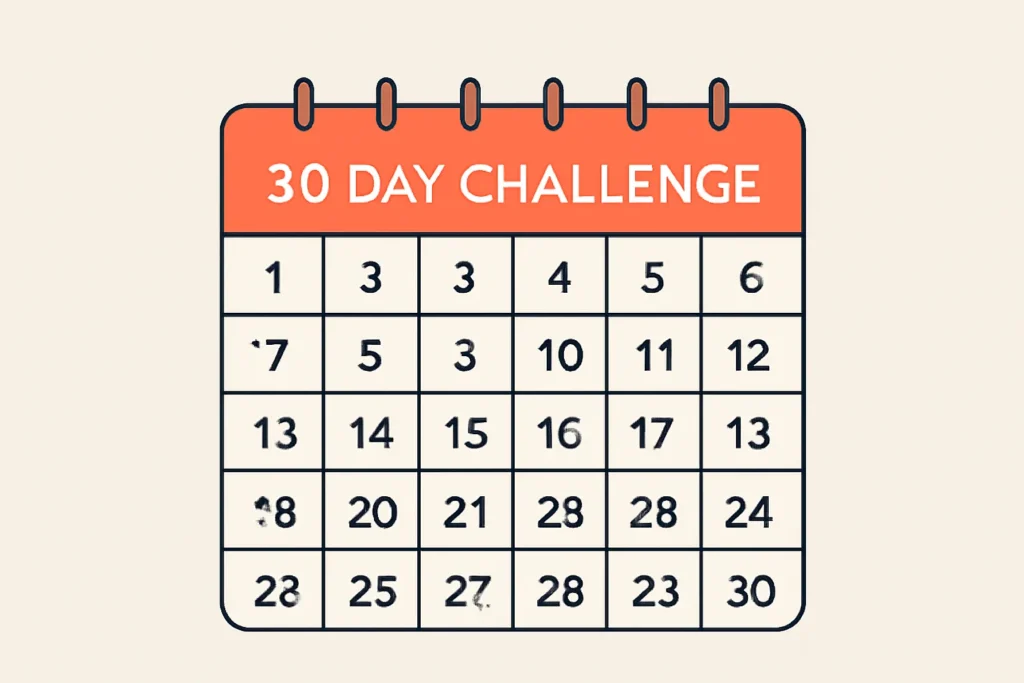
Grid-based calendars: A simple 5-by-6 grid (or 6-by-5) for Day 1 through Day 30 lets you see the entire month at a glance and provides ample space for notes per day.
List-oriented calendars: A vertical list with Day 1 to Day 30, each line containing a single daily task, checker boxes, and a notes area.
Habit-tracking sheets: A compact per-day row aligned with a few key habits, enabling quick cross-comparison of multiple routines on the same page.
Important elements to include
Date or Day label for each entry
Daily task or action statement
Completion checkbox or a simple color stamp
Notes/Reflection area for insights, obstacles, or adjustments
Progress summary section for weekly or monthly totals
Printable formats
Letter size (8.5 x 11 inches) with generous margins for writing
A4 size popular internationally, with slightly different margins
Compact pocket-size version for on-the-go planning
Practical ideas for using a 30-day challenge calendar
Regardless of your overarching goal, the following categories demonstrate how a 30-day challenge calendar can be applied to diverse areas of life. You can pick one focus or combine several to form a holistic plan.
Fitness and health
Daily movement: walk 20–30 minutes, jog, or do a short workout
Hydration and nutrition: drink X cups of water and include a fresh vegetable or fruit
Sleep hygiene: establish a consistent bedtime and wake-up time
Learning and personal development
Daily study: 25–30 minutes of focused learning
Skill practice: 15 minutes of deliberate practice for a chosen talent
Reading habit: read for 20–30 minutes daily
Productivity and routine building
Morning routine: plan the day, quick review of goals
Time blocking: allocate fixed times for key tasks
End-of-day reflection: journal or summarize what you accomplished
Creativity and journaling
Daily sketch, photograph, or writing prompt
Creative sprint: 30 minutes of focused creative work
Gratitude or reflective journaling: capture what went well
Customization and personalization
One of the strongest advantages of a free printable planner is the ability to tailor it to your taste and needs. Personalization can boost motivation and engagement, making the experience more enjoyable and sustainable.
Color coding and visual design
Use different colors to distinguish between types of tasks or goals, such as:
Blue for health and wellness
Green for learning and growth
Orange for work-related tasks
Color-coding helps your brain categorize information quickly and reinforces a sense of order.
Sections and add-ons
Enhance your calendar with optional sections such as:
Weekly goals at the top of each page
Habit strength tracker to show streaks
Motivation quotes or tiny challenges to keep energy high
Accessibility considerations
Ensure your calendar is accessible and easy to read. Use high-contrast text, larger font sizes if needed, and consider a layout that is friendly for people with visual or motor challenges. An oversized grid with bold day numbers and clearly labeled sections can make a big difference in usability.
Printable templates: choosing or creating the right one
Different templates exist for different preferences. Some people prefer a simple checklist, while others want a more comprehensive tracker. Here are common template styles you might encounter under the umbrella of the 30-day challenge calendar concept:
Basic checklist calendar: One task per day with a checkbox and a small notes area.
Habit-focused calendar: Tracks several small habits per day with a compact grid.
Goal-aligned calendar: Each day ties directly to a milestone in a larger project.
Reflection-driven calendar: Includes space for end-of-day thoughts and lessons learned.
When choosing a printable template, consider your goal, available writing space, printing method, and whether you plan to reuse the same calendar for multiple months or create a new one each cycle. A flexible thirty-day planner can be printed as a one-month resource or converted into a reusable pad with a binder or ring notebook.
Printing tips for best results
A successful print job ensures your daily goals are legible and legible in your chosen format. Here are practical tips to get clean, readable pages:
Use high-quality printer settings and standard card stock if you want durability for a couple of months.
Print in color if you plan to color-code or highlight tasks; otherwise, black-and-white prints work well and save ink.
Adjust margins to accommodate binding or to provide extra space for writing; check print previews before printing.
Print multiple copies for different rooms or for sharing with a accountability partner.
Incorporating a 30 day challenge calendar into daily life
To embed the calendar into routines, treat it as a living document. The days may be numbered, but your plan should feel flexible. The beauty of a calendar for a 30-day challenge is that it invites adaptation without abandoning structure. You can:
Adjust daily tasks if the original plan proves too hard or too easy.
Swap in alternative actions that still align with the overall goal.
Use the weekly reflections to re-prioritize and re-commit to the month’s plan.
Examples of 30-day challenge calendars in action
Here are a few real-world examples of how people use a thirty-day calendar to drive change. These illustrations show the versatility and practical impact of this tool.
Example 1: 30-day fitness sprint
Day 1–7: 20 minutes of cardio each day
Day 8–14: 25 minutes of cardio plus 10 minutes of strength work
Day 15–21: 30 minutes of cardio, core work, and flexibility
Day 22–30: mixed routines with one optional rest day
Example 2: 30-day language learning orbit
Daily: 15–20 minutes of vocabulary and pronunciation practice
Weekly: a short conversation with a partner or language exchange
Weekly review: revisit tough phrases and track improvement
Example 3: 30-day reading and reflection challenge
Daily: read 20–30 minutes
Daily note: one takeaway or new idea
End of week: summarize insights and plan next steps
Audience adaptability: who benefits from a 30 day challenge calendar?
Different people will appreciate the 30-day calendar for different reasons. It is especially helpful for:
Students who want to build study habits or improve test preparation.
Parents seeking to cultivate routines for themselves and their children.
Career changers who need a structured plan to acquire new skills.
Busy professionals who want to implement a time-efficient routine.
Aspiring creatives pursuing consistent practice or project milestones.
Common concerns and how to address them
As with any productivity tool, some people worry about potential downsides. Here are common concerns and practical responses:
Overwhelm: Start with a very small daily action; you can scale up as confidence grows.
Guilt from missed days: A missed day is data, not failure. Refocus the next day and keep going.
Lack of motivation: Use a short, powerful reward, accountability partner, or a visible progress indicator to rekindle energy.
Tracking progress: the psychology of the 30-day window
The 30-day time frame taps into a natural cycle of habit formation. Research and practical experience indicate that consistent practice over four weeks can lead to lasting change in many people. A monthly calendar format helps you:
Keep your goal top-of-mind without becoming overwhelming
See how daily choices accumulate into outcomes
Leverage the brain’s reward pathways through regular positive reinforcement
Accessibility and inclusivity in 30-day calendars
Inclusive design means creating calendars that work for diverse users. When you choose a template or create your own, consider:
Option to enlarge text or switch to larger paper sizes
Clear language and minimal jargon to avoid confusion
Frequently asked questions
Is a 30-day calendar the same as a habit tracker?
They are closely related. A 30-day calendar often includes a habit-tracking component, but you can use it primarily as a task tracker or a goal-oriented planner depending on how you set it up. The core idea is to capture daily actions and reflect on progress.
Can I reuse the same printable calendar for multiple months?
Yes, especially if you print on binders or use a reusable laminated page with dry-erase markers. Some people prefer to create a new 30-day calendar each month to reset goals and refresh motivation, while others keep a running record for continuity.
What size is best for a printable planner?
Common sizes are Letter (8.5 x 11 inches) and A4. The choice depends on your printing capabilities, whether you’ll bind or paste the calendar, and how much writing space you need per day.
Closing thoughts: making the most of a 30 day challenge calendar
A 30 day challenge calendar—also known as a thirty-day planner or a 30-day goal calendar—provides a practical, evidence-based approach to turning intention into habit. It is a compact engine for momentum, a customizable blueprint for daily progress, and a flexible tool that can adapt to different goals and lifestyles. By pairing a high-quality free printable with intentional use, you can transform your daily routine and unlock meaningful improvements over a single month.
Sample structure of a printable 30-day calendar page
If you are curious about what a typical page of a printable 30-day calendar looks like, here is a descriptive outline of a common layout. This outline is for illustration purposes and can be adapted to your preferred design:
Header: Month and a short goal statement
Day grid: 30 days arranged in a grid, with a day number and a small task field
Daily task: A brief, action-oriented prompt for the day (e.g., “Walk 20 minutes”)
Checklist: A checkbox to mark completion
Notes: A small blank area for reflections or adjustments
Weekly summary: A mini section to capture progress and insights from the past seven days
While this description is generic, the actual printable file you download or print can be customized to match your aesthetic and functional preferences. The key is to keep it human-friendly, actionable, and aligned with your goals for the month.
Let’s recap the core idea
To summarize, a 30 day challenge calendar is a practical tool for turning goals into daily action through a structured, printable format. By choosing a free printable planner, customizing it to your needs, and using it with discipline and reflection, you can achieve meaningful progress in 30 days or fewer. The concept leverages the power of small steps, short-term commitment, and visible progress to build lasting habits and improve self-efficacy.
If you’re ready to start, search for a high-quality thirty-day calendar template that fits your budget and style, print a few copies, and begin your first 30-day journey. Whether you call it a 30-day calendar, a thirty-day planner, a 30-day habit tracker, or a simple monthly challenge calendar, the essential idea remains the same: plan daily actions, track results, reflect, and grow. Now is the time to take action and set your goals into motion with a practical, printable tool that supports daily progress and long-term success.









Leave a Reply