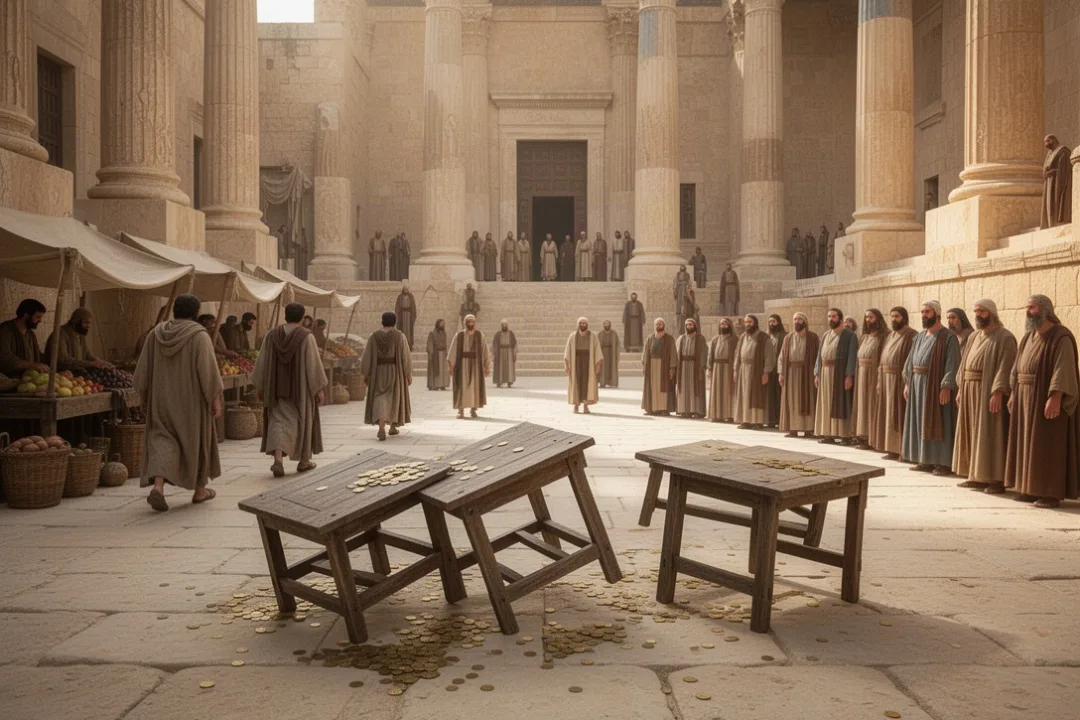
Have you ever walked into a place meant for reflection and found it dominated by noise, sales, and self-interest? That tension helps explain why the cleansing of the temple remains one of the most striking scenes in the Gospels. Jesus entered the Jerusalem temple, disrupted the buying and selling taking place in its courts, and challenged the leaders responsible for how sacred worship was being conducted.
The event was not a random outburst against commerce or an argument about religious buildings. It was a prophetic sign about the purpose of worship, the treatment of outsiders, and the danger of turning devotion into a system that benefits the powerful. The Gospel accounts show Jesus acting with deliberate authority, quoting Scripture through his actions, and pointing beyond the temple toward his own death and resurrection.
All four Gospels describe Jesus confronting activity in the Jerusalem temple, although they arrange and emphasize the episode differently. Matthew 21:12-17, Mark 11:15-19, and Luke 19:45-48 place it near the end of Jesus’ ministry, shortly after his arrival in Jerusalem. John 2:13-22 places a similar scene near the beginning of Jesus’ public ministry.
In the accounts, Jesus entered the temple area and saw people buying and selling animals. Money changers were present because pilgrims needed appropriate currency for temple-related payments, while sellers provided animals for sacrifices. Mark also describes Jesus preventing people from carrying merchandise through the temple courts.
Jesus overturned the tables of the money changers and the seats of those selling doves. The Gospel writers present this as a public confrontation, not a private complaint. The action communicated that the temple’s worship had been compromised by practices that treated a place of prayer as a place for commercial activity and personal advantage.
The sellers of doves receive particular attention because doves were associated with offerings made by people of limited means. In Leviticus 12, for example, a poor family could bring birds when it could not afford a lamb. Jesus’ challenge therefore reaches beyond general irritation with business: it raises questions about whether worship had become a burden for ordinary people.
Central idea: Jesus was not objecting to every practical service connected with worship. He was confronting a system in which sacred access, prayer, and sacrifice were being overshadowed by exploitation, exclusion, and misuse of God’s house.
The scene also includes healing and praise in Matthew’s account. After the disruption, blind and lame people came to Jesus in the temple, and he healed them. Children praised him, while the religious leaders became angry. This contrast matters: those who were vulnerable or receptive recognized God’s work, while some officials focused on protecting their authority and controlling the setting.
Why Jesus called the temple a house of prayer
Jesus interpreted his action through two important Old Testament passages. Matthew, Mark, and Luke connect the temple to Isaiah 56:7, where God’s house is described as a place of prayer for all nations. Jesus’ words, as summarized by the Gospel writers, restore attention to the temple’s intended purpose: it was meant to draw people toward God, not become a barrier that served a religious marketplace.
The phrase “for all nations” is especially significant. The temple included areas associated with Gentile worship, and the activity Jesus confronted may have crowded or disrupted the court where non-Jews could seek God. The cleansing therefore concerns the welcome of outsiders as well as the purity of Israel’s worship.
A temple can be formally religious while failing in its mission. If people who are seeking God encounter intimidation, exploitation, noise, or exclusion, the institution has contradicted the purpose it claims to represent. Jesus’ action exposes that contradiction in a visible and unforgettable way.
Jesus also drew on Jeremiah 7:11, which describes the temple as a “den of robbers.” The point of Jeremiah’s message was not merely that theft had occurred inside a religious building. The prophet confronted people who used the temple as a shelter for wrongdoing, assuming religious activity could protect them from judgment while they continued to oppress others.
That background gives the phrase a wider meaning. A “den” is a place where robbers retreat after committing their crimes. Jesus was accusing the temple establishment of allowing worship to become a cover for injustice, rather than a place where people were changed and where the vulnerable were treated fairly.
Isaiah 56:7 supplies the positive vision: God’s house should be a place of prayer for all peoples.
Jeremiah 7:11 supplies the warning: religious space must not become a refuge for exploitation and hypocrisy.
Jesus’ actions bring both passages together as a public call to restore worship and confront corruption.
The cleansing of the temple is therefore not a narrow lesson about keeping a sanctuary quiet. It asks whether religious practices actually reflect God’s concern for prayer, holiness, justice, and welcome. The question applies to institutions, leaders, communities, and individual believers.
What Jesus was confronting in the temple courts
The Gospels do not provide a full economic description of the temple system, so it is unwise to claim that every money changer or animal seller was personally dishonest. Pilgrims needed animals for sacrifice, and currency exchange had a practical function. The problem was the way these necessary services had become intertwined with the temple’s authority and with practices that could exploit worshipers.
People traveled long distances to Jerusalem for major festivals. They could not always bring sacrificial animals with them, and they might need local currency for religious obligations. Sellers and money changers could therefore serve a legitimate need. Jesus’ protest shows that useful services can still become corrupt when profit, control, or convenience takes precedence over worship.
The physical location also mattered. The temple was not simply a private prayer room. It was the center of Israel’s worship and a symbol of God’s covenant presence. Activity in its courts shaped who could pray, who could participate, and what pilgrims experienced when they arrived. Conduct that crowded out prayer was a spiritual problem even if it could be defended as economically practical.
Mark’s account says that Jesus would not allow people to carry merchandise through the temple. This detail suggests that the issue included the temple being treated as a shortcut or public thoroughfare. A place dedicated to God had become ordinary space for transactions and traffic. The loss was not only financial fairness but also reverence and purpose.
Jesus’ confrontation also challenged the leaders who permitted the system. The chief priests and teachers of the law began looking for a way to destroy him, according to Mark and Luke. Their response indicates that the incident threatened more than an arrangement among vendors. It challenged the authority and interests of people who controlled the religious center.
At the same time, the temple cleansing should not be turned into a simple accusation against a whole ethnic or religious group. Jesus, his disciples, the pilgrims, and the temple authorities were all part of the Jewish world of his time. His critique came from within Israel’s Scriptures and covenant hopes. He was acting as a Jewish prophet confronting the misuse of Israel’s worship, not attacking Judaism as such.
Why the event was more than a complaint about money
Reducing the episode to “Jesus disliked merchants in church” misses its prophetic force. The central issue was what worship is for. Buying and selling became a symbol of a larger failure: people were approaching God through a system that could prioritize transaction, status, and institutional control over mercy and prayer.
The story also reveals that Jesus’ concern for worship and justice cannot be separated. A community cannot claim to honor God while making access difficult for the poor, outsiders, or people without influence. Sacred language does not excuse unfair treatment. The cleansing of the temple joins devotion to ethical responsibility.
There is a practical lesson here for religious organizations. Buildings, programs, budgets, and staff may all serve a good purpose, but they can gradually become ends in themselves. The test is whether they help people pray, encounter truth, receive care, and participate in the life of the community—or whether they primarily protect revenue, reputation, and authority.
How the four Gospel accounts differ
Readers often notice that John places the cleansing near the start of Jesus’ ministry, while the other three Gospels place it during the final week before his crucifixion. This difference has led to two main interpretations: Jesus cleansed the temple twice, or the Gospel writers arranged the event differently to emphasize its meaning.
The text itself does not settle the question with complete certainty. Matthew, Mark, and Luke present the event as a major act leading directly to conflict in Jerusalem. John presents it early and connects it with Jesus’ identity, his authority over the temple, and the sign of resurrection. Both arrangements serve theological purposes.
Matthew emphasizes Jesus’ healing of the blind and lame and the praise of children. This makes the temple scene part of a larger revelation of Jesus as the promised king whose authority challenges the religious leaders. The leaders see the praise and become indignant, but Jesus defends it by referring to Scripture.
Mark gives the most detailed sequence of the event and places it within a pattern involving a fig tree. The temple action appears between the two parts of that symbolic episode. Mark’s presentation links the temple’s failure to produce faithful worship with the broader theme of judgment on fruitlessness.
Luke uses a concise description of Jesus driving out those who sold in the temple. He then says that Jesus taught there daily. This creates a sharp contrast between the temple as a place of instruction and prayer and the temple as a place overtaken by commerce. Luke also highlights the people listening closely, while the leaders seek to destroy Jesus.
John includes details not found in the Synoptic accounts, including Jesus making a whip of cords and telling those selling doves to remove them. John connects the disciples’ later understanding of the event with Psalm 69, portraying Jesus as consumed by zeal for God’s house. He also records Jesus speaking about the temple of his body, which the disciples understand after his resurrection.
Rather than forcing every Gospel into identical wording or chronology, you can read each account on its own terms. Together they show several dimensions of the event:
Public judgment: Jesus confronts a system that has violated the temple’s purpose.
Prophetic fulfillment: His actions echo Israel’s Scriptures concerning prayer, justice, and covenant faithfulness.
Messianic authority: Jesus acts as one with authority to evaluate the heart of Israel’s worship.
Resurrection meaning: In John, the temple points toward Jesus’ body and the new way God’s presence will be understood.
The differences do not erase the common message. In every Gospel, Jesus’ action provokes opposition and points to a profound redefinition of worship. The temple is no longer treated as an institution beyond examination. Its practices are placed under the authority of the one who speaks and acts in God’s name.
How the cleansing of the temple points to Jesus’ death and resurrection
The temple incident takes place within the growing conflict that leads to Jesus’ crucifixion. In the Synoptic Gospels, the chief priests and teachers begin seeking a way to kill him after the event. His public challenge has exposed the religious leadership and threatened the stability of a system centered on the temple.
John makes the connection even more direct. When challenged to provide a sign for his authority, Jesus refers to the destruction and raising of the temple, while speaking about his body. The disciples understand the statement only later, after Jesus rises from the dead. John’s point is that Jesus himself becomes the decisive meeting place between God and humanity.
This does not mean the physical temple was meaningless or that the Old Testament worship system had been worthless. It means that Jesus’ death and resurrection bring God’s presence, forgiveness, and access into a new focus. The temple symbolism reaches its fulfillment in the person of Christ rather than remaining centered only on a building and its rituals.
The connection with resurrection also changes how readers understand Jesus’ anger. The cleansing is an act of judgment, but it is not judgment without hope. Jesus confronts a corrupted form of worship while opening the way to restored communion with God. The event warns against false worship and points toward a deeper form of worship shaped by his life, death, and resurrection.
For Christians, this theme continues in passages such as 1 Corinthians 3:16-17 and 6:19, which describe God’s people and individual believers as temples of the Holy Spirit. These references should not be used to erase the historical meaning of Jerusalem’s temple, but they do extend the question inward and outward. Where God’s Spirit dwells, the community’s life must reflect holiness, integrity, and care for others.
A useful question: If your church, ministry, or personal faith practice were judged by the temple’s intended purpose, would it make prayer, truth, mercy, and welcome easier for people to encounter?
The cleansing therefore reaches beyond a past scene. It asks what has occupied the center of worship. Money can become central, but so can reputation, political influence, performance, tradition, or the desire to control others. Anything that pushes prayer, justice, and faithful attention to God into the margins deserves honest examination.
What the cleansing of the temple means for Christians today
The first application is not to imitate Jesus by creating disorder or confronting people aggressively. The Gospels present a unique prophetic action by Jesus, whose authority and role cannot simply be transferred to every individual. Christians should resist using the story to justify anger, intimidation, or destructive behavior.
The appropriate response begins with self-examination. Religious activity can appear healthy from the outside while being shaped by fear, pride, financial pressure, or the need for control. Individuals and congregations can ask whether their practices help people draw near to God or quietly place status and institutional interests first.
Several questions can make that examination concrete:
Are people welcomed regardless of their income, background, disability, nationality, or social standing?
Are financial requests explained honestly, without manipulating fear or promising guaranteed spiritual results?
Do leaders accept accountability, or are they protected from reasonable questions?
Does the community make room for prayer, teaching, repentance, and silence?
Are vulnerable people listened to and protected rather than treated as inconveniences?
Do programs and traditions serve people, or are people expected to serve the institution?
The second application concerns the relationship between worship and justice. Jesus’ use of Isaiah and Jeremiah shows that prayer cannot be isolated from how people are treated. A congregation may use faithful language, beautiful music, and careful rituals, yet still contradict its worship if it ignores exploitation or excludes those who need care.
The third application concerns money. Scripture does not treat every exchange of money for goods or services as automatically sinful. Churches need resources, workers may deserve fair pay, and practical arrangements are sometimes necessary. The warning is against allowing financial activity to control spiritual access or turning people’s hopes, fears, and needs into opportunities for manipulation.
The fourth application is positive: sacred spaces and practices should help people attend to God. A church building does not contain God in the same way the Jerusalem temple represented God’s presence in Israel, but physical surroundings still shape worship. Order, hospitality, truthful teaching, and thoughtful care can create conditions in which people are better able to pray and listen.
Finally, the story directs attention to Jesus himself. The cleansing is not merely a lesson about church management. It reveals his authority, his commitment to the purposes of Scripture, his concern for outsiders and the vulnerable, and his willingness to confront powerful leaders. It also points to the resurrection, through which Christians understand Jesus as the true center of access to God.
The most faithful response is neither to soften the scene into a harmless lesson about manners nor to use it as permission for hostility. It is to let Jesus’ action expose false priorities. Worship should lead toward prayer, holiness, justice, mercy, and trust in Christ. When those purposes are displaced, the cleansing of the temple remains a necessary warning.
Frequently asked questions
Did Jesus cleanse the temple once or twice?
The Synoptic Gospels place the event during Jesus’ final week in Jerusalem, while John places a similar event near the beginning of his ministry. Some readers understand these as two separate cleansings; others believe John arranges the account thematically. The Gospels clearly agree on the central meaning: Jesus confronted the misuse of the temple and its authority.
Was Jesus condemning all buying and selling in religious settings?
No. The Gospel accounts do not establish that every seller or money changer was personally dishonest, and practical services were needed by pilgrims. Jesus opposed the way commerce had displaced prayer and enabled religious power to burden or exclude people. The warning concerns exploitation, misplaced priorities, and profit controlling access to worship.
Why did Jesus mention a “den of robbers”?
The phrase echoes Jeremiah 7:11, where the prophet criticizes people who commit injustice and then treat the temple as protection from judgment. Jesus was not simply accusing every person present of theft. He was exposing a religious system that could shelter corruption while appearing devoted to God.
How should Christians apply this story without becoming aggressive?
The event calls for honest examination of personal and institutional priorities, not permission for intimidation or violence. Christians can ask whether their communities welcome outsiders, protect vulnerable people, handle money transparently, and make room for prayer. Jesus’ authority in this prophetic act should not be used to excuse uncontrolled anger or destructive behavior.








Leave a Reply