Overview: Understanding the phrase at the heart of Luke 20:25
The biblical line “Render unto Caesar the things that are Caesar’s, and unto God the things that are God’s” sits at a pivotal intersection of religion, politics, and personal conscience. In Luke 20:25, Jesus navigates a delicate trap set by opponents who want to force him into a political controversy or a theological blunder. His response has resonated through the centuries because it acknowledges civil obligations while affirming ultimate allegiance to God. This article explores the meaning, the historical context, and how to apply Luke 20:25 in contemporary life.
Historical and literary context: who asked the question and why it mattered
To grasp the significance of Luke 20:25, it's essential to understand the setting. In the Gospels, Jesus faces a sequence of tricky questions from religious leaders who want to trap him. In this episode, the question comes from a coalition of groups known for their opposing political viewpoints, often described as the Pharisees and the Herodians. Their alliance against Jesus demonstrates how political factions surrounded him and were ready to manipulate religious rhetoric for their purposes.
The broader scene is built around a tax question—an issue that touched every citizen. The Romans demanded taxes, and paying them could be seen as an endorsement of imperial authority, while withholding tax might be framed as resistance to oppression. The matter of Caesar’s coins is not incidental: the denarius bore the image of Caesar, a striking symbol that Jesus uses to frame his answer. In the social imagination of the time, coins carried more than monetary value; they carried political and social meaning.
The denarius, the image, and the question of allegiance
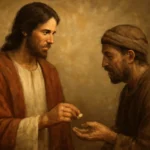
The denarius, a coin in circulation during Jesus’ day, was a tangible reminder of Caesar’s rule and the tax obligations that came with citizenship in the Roman world. The coin’s imagery—Caesar’s portrait—was not merely decorative: it signified political sovereignty. When Jesus is asked whether it is right to pay the tax, he points to the coin as a physical reminder of the authority the coin represents. This moment can be read in two directions:
On one level, it acknowledges the legitimate civil authority that taxes and governance exercise in society.
On another level, it surfaces the question of ultimate loyalty: God’s ownership of all life versus human institutions that wield power in the present age.
The core question becomes a practical one: To what extent should a follower of God participate in civil structures, taxation, and legal obligations, especially when those structures may diverge from divine standards? Jesus’ answer positions the matter not as a stark choice between obedience to Caesar or God alone, but as a call to honor both domains in their proper spheres.
Luke 20:25: the verse and its precise meaning
The verse itself is compact, but its implications are expansive. The exact wording in the King James Version is: “Render therefore unto Caesar the things which are Caesar’s, and unto God the things that are God’s.” Modern translations render the phrase with similar meaning, emphasizing two distinct obligations:
Render unto Caesar the things that are Caesar’s: This clause recognizes civil authority and obligations tied to social life—such as taxes, civic duties, obedience to laws, and respect for legitimate governmental structures.
Render unto God the things that are God’s: This clause asserts that there are realms where God alone is sovereign—the things of worship, conscience, soul, and worshipful allegiance.
The balance suggested here is not a separation of church and state in a modern legal sense, but a nuanced approach to loyalty and responsibility in a world where human institutions exist alongside divine authority. In practice, this means recognizing that some obligations are civic (like taxes) while others are spiritual (like worship, moral obedience, and trust in God’s sovereignty).
Key interpretations: how theologians and scholars have understood the teaching
Across generations, scholars have highlighted several core interpretations of Render unto Caesar and its broader implications. Here are some of the major strands:
Two kingdoms / two realms: A common reading is that Jesus acknowledges two sovereign realms—an earthly realm (Caesar’s) and a heavenly realm (God’s). Each has its own legitimate domain, and neither should be conflated with the other.
Civic responsibility: The verse is often cited to affirm a believer’s duty to participate in civic life and to comply with laws and taxes, so long as those demands do not require disobedience to God’s commands.
Limitations on civil power: By distinguishing God’s things from Caesar’s, the passage implies that civil authority has limits and is answerable to the divine standard. When civil power commands what God forbids, the higher loyalty remains with God.
Conscience and worship: The emphasis on “the things that are God’s” highlights the primacy of worship, conscience, and allegiance to God in human life, above political or economic demands that would compromise faithfulness to God.
Some traditions emphasize the phrase’s instructive value for church-state relations in particular, arguing for a measured separation that preserves religious freedom while acknowledging legitimate civil governance. Other traditions highlight the need for social justice and accountability in governance, prompting believers to engage in the public square with wisdom and compassion.
Applications today: how to live out Luke 20:25 in modern life
How should contemporary Christians apply Luke 20:25 in daily life? The following sections outline practical categories for reflection and action.
1. Civic duties and taxation: recognizing legitimate authority
The instruction to render unto Caesar supports a practical ethic of civic responsibility. This includes:
Paying taxes honestly and promptly, as a part of contributing to the common good.
Obeying laws that do not compel us to violate God’s commands.
Participating in civic processes when possible—voting, community service, and public dialogue—while maintaining a critical but respectful stance toward government power.
The article of faith here is not blind subservience to government but responsible citizenship that seeks to honor God through just, peaceful, and constructive civic engagement.
2. Faith, worship, and conscience: where God’s sovereignty is supreme
The counterpart to civil obligation is fidelity to God. When civil demands conflict with God’s revealed will, the believer is called to obedience to God. This does not automatically justify civil disobedience, but it provides a framework for discerning when a higher allegiance is required. In practice:
Worship and prayer remain non-negotiable acts of devotion, even in the face of pressure to conform to secular norms that violate conscience.
Conscience, guided by scriptural integrity, becomes a guardrail for decisions that involve moral and ethical questions in public life.
Church and community leaders can help believers discern how to honor God while engaging with society’s structures in constructive ways.
3. Economic life and stewardship: money, image, and responsibility
The coin imagery in Luke 20:25 invites reflection on what it means to use money loyally and justly. Christians are invited to view wealth through the lens of stewardship and divine ownership:
Money is a tool for human flourishing, not a deity to be worshiped.
Economic decisions should reflect integrity, generosity, and concern for the vulnerable.
Financial support for churches, charities, and communities can be guided by virtue and wisdom, rather than fear or greed.
4. Peaceful engagement and public witness
A key application is to engage in public life with wisdom, discernment, and peace. This includes:
Advocating for policies that protect human dignity and promote justice.
Engaging in civil dialogue that respects opponents while clearly articulating moral perspectives.
Using nonviolent methods to address grievances and pursue reform when necessary.
The directive to render unto Caesar has sometimes been cited to support a simplistic stance that civil obedience equals moral endorsement of government. A more careful reading shows several nuances:
Not all obedience is absolute: The divine command to love God and neighbor supersedes civil obedience when the latter demands disobedience to God’s commands.
Not all disobedience is rebellion: Civil resistance may be a legitimate, nonviolent means to pursue justice and protect the vulnerable.
Context matters: The historical setting—Roman taxation and imperial authority—shapes how the teaching functions today in different cultural and political environments.
Applications differ by tradition: Various Christian traditions interpret the balance between church and state differently, but the core remains a call to integrity, mercy, and faithfulness to God.
Frequently asked questions
Here are some common questions people ask about this passage, along with brief clarifications:
Does Jesus’ command justify paying taxes in all circumstances? In broad terms, yes, but the right moral posture is not mere compliance; it is a faithful participation that honors both civil life and divine allegiance.
Can Christians advocate for radical political change? Yes, when such advocacy aims at justice, mercy, and human dignity, while remaining under the surpassing authority of God.
What about government oppression? The call to render unto God remains, and believers are urged to seek justice and work toward freedom while maintaining a nonviolent witness.
Variations on the phrase: expanding the semantic field
To deepen understanding, it helps to explore how phrases related to Render unto Caesar are used in spiritual discourse. Some common variants and related expressions include:
Give unto the state what belongs to the state—a reformulation that emphasizes civil responsibilities such as taxation and obedience to laws.
Render unto government the things due to government—acknowledging the legitimacy of political authority while reserving ultimate worship for God.
Pay to Caesar the things that bear his image—highlighting the symbolic link between financial obligations and political sovereignty.
Offer to God the things that belong to God—emphasizing worship, devotion, and conscience as belonging to God alone.
Balance between obedience and conscience—a shorthand way of describing the broader ethical stance encouraged by the passage.
These variations are not mere synonyms; they reflect different emphases and pastoral concerns—whether stressed is the legitimacy of civil authority, the primacy of worship, or the practical duties of citizenship.
Historical impact and theological significance
The teaching in Luke 20:25 has influenced centuries of Christian thought about the relationship between church and state. It has been invoked by:
theologians who champion a restrained stance toward political power while affirming social responsibility;
pastors who teach congregations to participate in civic life with integrity and mercy; and
lawmakers and citizens who seek to shape policy in ways that honor human dignity and reflect Biblical ethics.
Beyond politics, the verse has shaped moral reflection on ownership, stewardship, and the nature of true allegiance. It invites believers to consider: What does it mean to live as citizens of two realms, without softening the demands of either?
Luke 20:25 offers more than a clever retort to a political trap. It presents a durable framework for thinking about authority, responsibility, and loyalty. The principle of rendering unto Caesar acknowledges legitimate civil authority and the need to participate in society with integrity. The companion principle of rendering unto God grounds life and conduct in the ultimate allegiance to God. For modern readers, the teaching remains a call to thoughtful citizenship, compassionate public witness, and steadfast faithfulness—an invitation to engage the world with both discernment and mercy.
Whether one approaches this passage from a pastoral, ethical, or political angle, the core message endures: live in a way that respects civil order where possible, while preserving the primacy of God in worship, conscience, and ultimate purpose.








Leave a Reply